
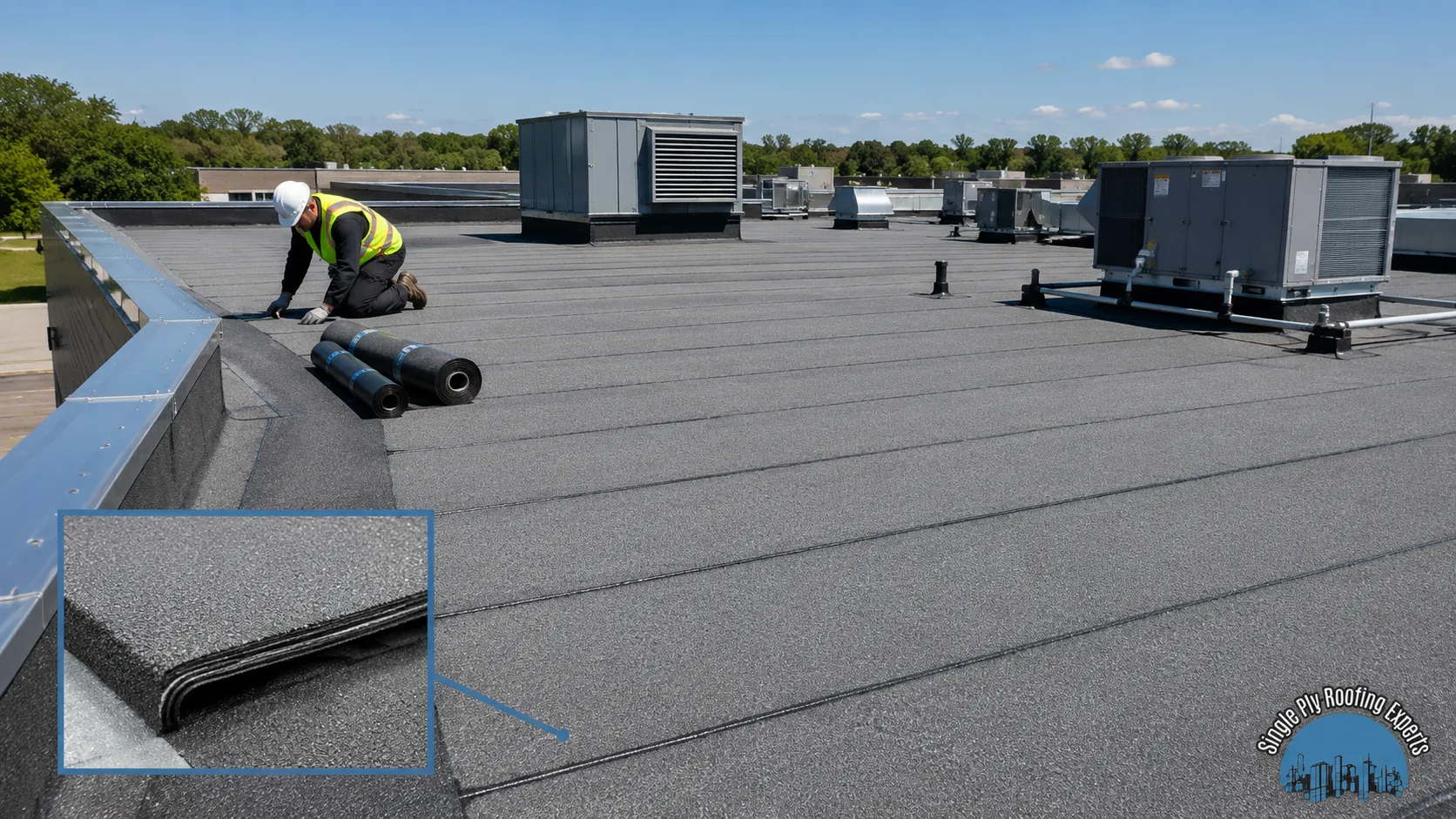
Modified bitumen has been used on flat and low-slope roofs for decades because it combines asphalt-based waterproofing with modern polymer reinforcement. But not every modified bitumen membrane is built or installed the same way. If you are comparing roofing options for a commercial building, multifamily property, HOA, home, addition, or another low-slope structure, understanding the different systems can make conversations with your roofing contractor much more productive.
The two primary types of modified bitumen roofing are APP and SBS. APP uses atactic polypropylene to modify the asphalt, giving the membrane more plastic-like characteristics and strong resistance to heat. SBS uses styrene-butadiene-styrene, which gives the material more rubber-like flexibility and elasticity.
That is only the beginning of the distinction. Modified bitumen roofs can also differ according to installation method, reinforcement, surface finish, number of plies, and the way the overall roof assembly is designed. Those differences affect how a roof responds to heat, movement, foot traffic, drainage conditions, repairs, and long-term exposure.
This guide explains the major types, how they differ, where each may make sense, and what commercial and residential property owners should consider before deciding on a roofing system.
What Is Modified Bitumen Roofing?
Before comparing the types of modified bitumen roofing, it helps to understand what makes this material different from other flat-roof systems.
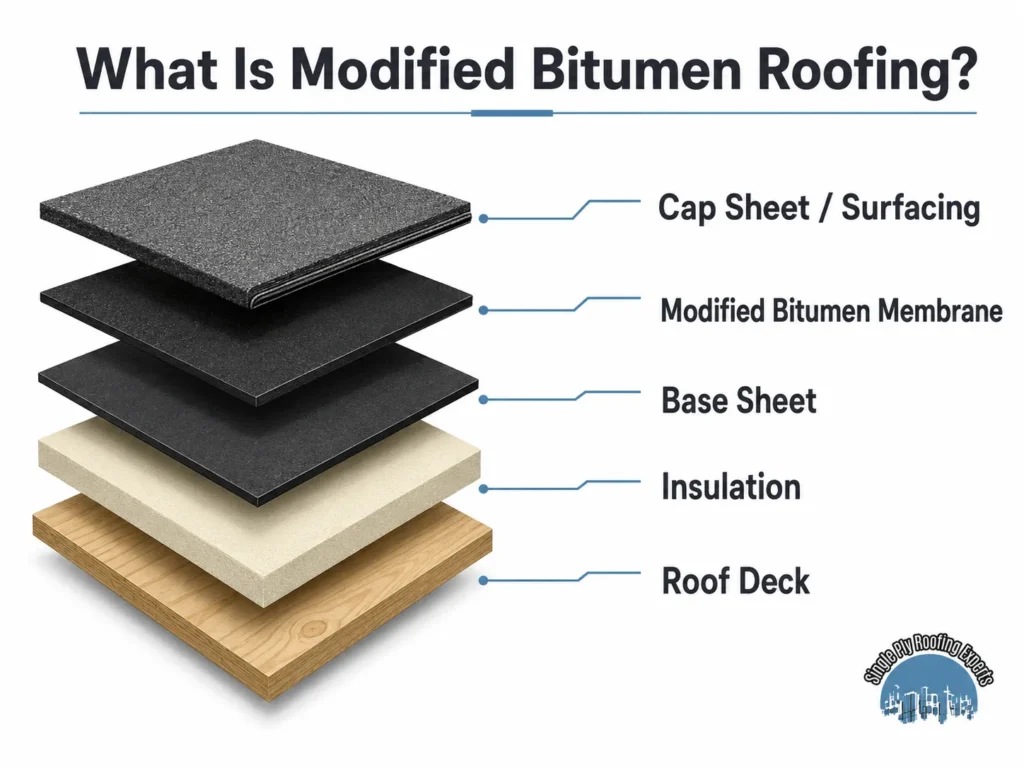
Modified bitumen is an asphalt-based roofing membrane enhanced with polymers that change how the material responds to temperature, movement, weathering, and physical stress.
What Is a Modified Bitumen Membrane Made Of?
A modified bitumen membrane begins with asphalt, but the asphalt is blended with polymers rather than being used by itself. Reinforcing materials such as polyester or fiberglass are incorporated into the membrane to improve its strength, stability, and resistance to tearing.
The finished membrane is manufactured in rolls. Depending on the product and roof assembly, the sheets may serve as base layers, intermediate plies, or exposed cap sheets.
A complete roof is more than the membrane visible from above. The assembly may also include the structural deck, insulation, cover board, base sheets, modified bitumen plies, flashing components, adhesives or attachment systems, and a protective surface.
The National Roofing Contractors Association has published extensive information about the performance and design considerations of APP and SBS modified bitumen roofing systems, reflecting how established both membrane categories are within low-slope roofing.
How Is Modified Bitumen Different From Traditional Built-Up Roofing?
Modified bitumen and built-up roofing share an asphalt-based heritage, but their construction is different. Traditional built-up roofing typically creates a waterproof assembly in the field by installing multiple layers of reinforcing material and bitumen. Modified bitumen incorporates much of that asphalt and reinforcement into factory-manufactured sheets.
This manufacturing process creates more consistent individual membranes while preserving many of the characteristics that make multi-layer asphaltic roof systems attractive for flat and low-slope buildings.
Modified bitumen should also not be confused with thermoplastic or rubber single-ply membranes such as TPO, PVC, and EPDM. Those systems use different materials, seam technologies, and assembly designs.
What Are the Two Main Types of Modified Bitumen Roofing?
When contractors and manufacturers discuss the primary types of modified bitumen roofing, they are usually referring to APP and SBS.
These names describe the polymer used to modify the asphalt, and that polymer has a significant effect on how the finished membrane behaves.
APP Modified Bitumen Roofing
APP stands for atactic polypropylene. Adding this polymer gives the asphalt more plastic-like characteristics and improves its ability to handle elevated temperatures and prolonged exposure to demanding rooftop conditions.
APP membranes are frequently associated with heat-applied or torch-applied installation, although the exact approved installation method depends on the roof system and manufacturer.
Because of its heat-related performance characteristics, APP often enters the conversation on roofs exposed to intense sunlight and high surface temperatures. However, climate alone should never determine the membrane. The existing roof, roof deck, drainage, building use, attachment requirements, surfacing, and installation restrictions must also be evaluated.
SBS Modified Bitumen Roofing
SBS stands for styrene-butadiene-styrene. This modifier gives asphalt more rubber-like characteristics, allowing the membrane to flex and recover as the roof assembly responds to temperature changes and movement.
SBS roofing is available in systems designed for different application methods, including self-adhered, cold-applied, hot-asphalt, and certain heat-applied assemblies. That installation flexibility can make SBS relevant to a wide range of commercial and residential flat-roof projects.
Its elasticity can also be useful on roofs where movement, complex detailing, penetrations, or changing temperatures make flexibility an important consideration.
Property owners evaluating these systems can learn more about professional modified bitumen roofing services before deciding whether an APP, SBS, repair, recover, or replacement approach fits the existing roof.
APP vs. SBS Modified Bitumen: What Is the Difference?
Understanding the types of modified bitumen roofing ultimately comes down to understanding how APP and SBS behave differently.
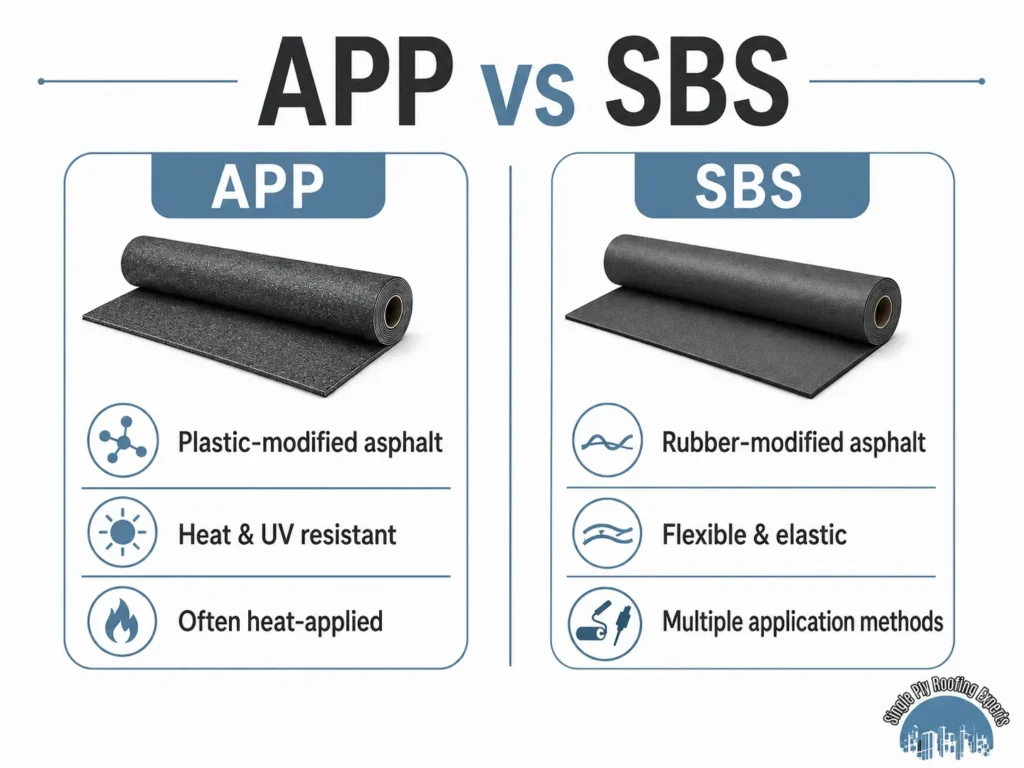
Neither material is automatically superior. The better system is the one that matches the building, climate, roof assembly, installation conditions, and long-term maintenance strategy.
Flexibility, Heat, and Building Movement
APP tends to behave more like a plastic-modified asphalt membrane. It is generally valued for stability at elevated temperatures and performance under significant solar exposure.
SBS behaves more like rubber-modified asphalt. Its elasticity allows it to accommodate movement and flexing more readily.
This does not mean every hot-climate roof should receive APP or every building that moves should automatically receive SBS. Roof performance depends on the entire assembly. Insulation, substrate, number of membrane plies, surfacing, attachment, drainage, flashings, penetrations, workmanship, and maintenance can all influence the outcome.
Installation and Project Conditions
Another major difference is how each membrane can be incorporated into an approved roof assembly.
APP is commonly associated with heat-fused installation. SBS is available across a broader mix of application approaches, depending on the product.
For building owners, this matters because the best installation method may be influenced by occupancy, combustible materials, rooftop equipment, access, odors, fire-control procedures, project scheduling, and the amount of disruption that can be tolerated.
The current federal Modified Bituminous Membrane Roofing specification guidance also illustrates why the substrate, materials, installation method, and fire considerations need to be evaluated together rather than treating membrane selection as a product-only decision.
Types of Modified Bitumen Roofing by Installation Method
The types of modified bitumen roofing can also be described by the way the membrane is attached to the roof. Installation method is separate from polymer type.
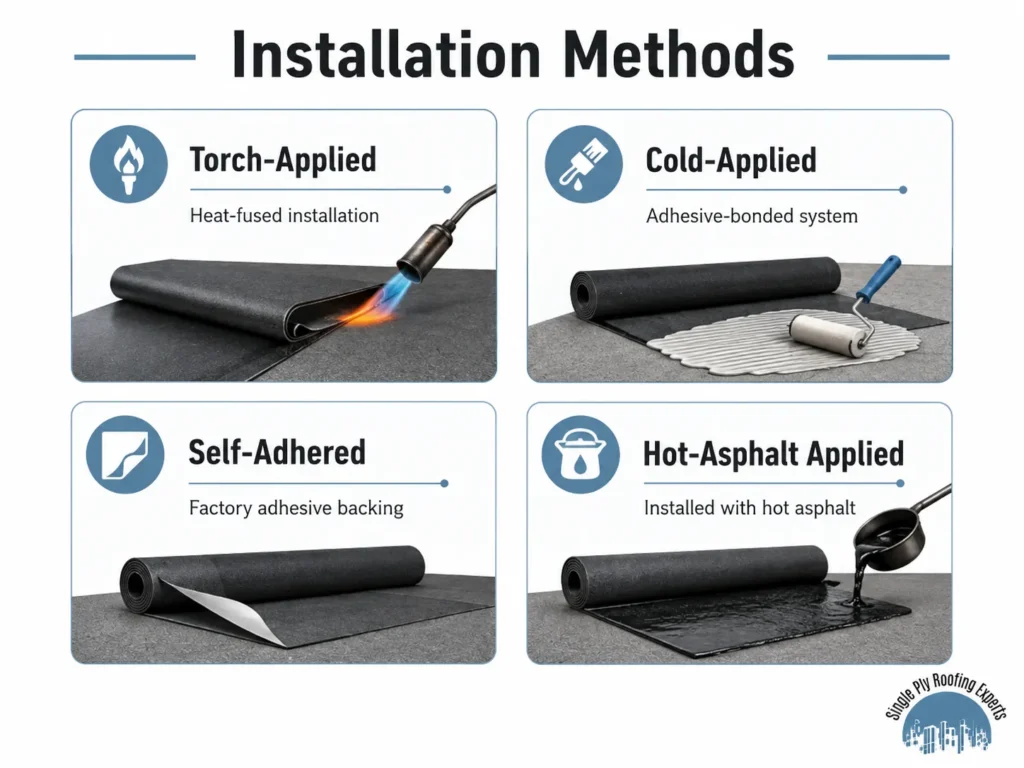
In other words, “torch-down” describes how certain membranes are installed, while APP and SBS describe what type of polymer modifies the asphalt.
Torch-Applied Modified Bitumen
Torch-applied roofing uses controlled heat to soften the underside of the membrane as it is rolled into place. This process bonds the membrane to the prepared substrate or underlying sheet.
Torch application is strongly associated with modified bitumen roofing, particularly APP systems. When performed properly within an appropriate assembly, it can create firmly bonded sheets and seams.
The obvious consideration is the use of an open flame. Building materials, roof decks, wall conditions, penetrations, rooftop equipment, occupancy, fire-control procedures, and local requirements all affect whether torch application is appropriate.
A contractor should evaluate those conditions before selecting an installation method rather than assuming torch application is suitable for every flat roof.
Cold-Applied Modified Bitumen
Cold-applied systems use compatible adhesives instead of an open flame to bond the roofing membrane. This can be useful where torching is undesirable or restricted.
The term “cold-applied” does not mean installation conditions are irrelevant. Surface preparation, adhesive compatibility, weather, substrate condition, curing requirements, and application rates still matter.
For occupied commercial properties, project logistics may be particularly important. Building owners should consider not only the finished roofing membrane but also how the installation will affect tenants, staff, customers, equipment, and normal operations.
Self-Adhered Modified Bitumen
Self-adhered membranes include a factory-applied adhesive layer protected by a release film. During installation, the release layer is removed and the membrane is bonded to an approved prepared substrate.
These systems eliminate the need for torching the membrane and can simplify certain installation conditions. However, that does not make them peel-and-stick products that can simply be placed over any existing surface.
The deck or underlying layer must be properly prepared, environmental conditions must fall within the product requirements, and seams, penetrations, transitions, and perimeter details still require professional installation.
Hot-Asphalt Applied Modified Bitumen
Certain modified bitumen assemblies can be installed using hot asphalt to adhere the roofing layers. This approach shares some installation characteristics with traditional built-up roofing.
Temperature control, compatibility, application technique, building access, odors, and project safety become important considerations. Because several installation technologies are available today, the appropriate method should be selected according to the specific roof assembly rather than habit or convenience.
Types of Modified Bitumen Roofing by Reinforcement and Surface Finish
The types of modified bitumen roofing are not defined only by APP and SBS. Membranes also vary according to their internal reinforcement and exterior finish, and those differences influence dimensional stability, flexibility, weather exposure, and the role each sheet plays within the roof assembly.
Polyester-Reinforced Modified Bitumen
Polyester reinforcement is commonly used where flexibility, elongation, and resistance to tearing are important characteristics. The reinforcing carrier sits within the modified asphalt and helps the membrane maintain strength as it responds to stress.
The finished performance still depends on the complete membrane formulation, so reinforcement should not be evaluated separately from the polymer, membrane thickness, surfacing, and roof design.
Fiberglass and Combination Reinforcement
Fiberglass reinforcement can provide dimensional stability and structural support within the membrane. Some roofing products use combinations of reinforcement materials to balance different performance characteristics.
For property owners, the practical lesson is that two membranes carrying the same broad APP or SBS label may not be identical. Product construction and approved assembly specifications matter.
Granule-Surfaced, Smooth, and Reflective Membranes
The exposed side of a modified bitumen membrane can also vary. Mineral granules are commonly used on cap sheets to protect the asphaltic material from direct weathering and ultraviolet exposure.
Smooth-surfaced sheets may be used within multi-layer assemblies or paired with compatible protective coatings when the roof design calls for them.
Reflective cap sheets and compatible reflective coatings can also be considered where reducing roof surface heat gain is part of the project objective. This can be particularly relevant on highly exposed flat roofs in sunny climates, although reflectivity should be evaluated together with insulation, drainage, roof condition, HVAC loads, and applicable energy requirements.
Benefits of Modified Bitumen Roofing
Different types of modified bitumen roofing offer different performance characteristics, but the system category as a whole remains attractive because it can combine reinforced membranes, asphalt-based waterproofing, multiple layers, and durable exposed surfaces.
Durable Waterproofing for Flat and Low-Slope Roofs
Flat roofs do not shed water as quickly as steep-slope roofs, so membrane continuity, seams, penetrations, flashings, and drainage details are critical.
Modified bitumen creates a continuous waterproofing layer designed for these low-slope conditions. Multi-ply configurations can also provide additional redundancy compared with relying on a single exposed membrane layer.
This makes modified bitumen relevant to many warehouses, retail properties, multifamily buildings, offices, commercial facilities, additions, garages, patios, and homes with low-slope roof areas.
For a broader look at these applications, see Single Ply Roofing Experts’ flat roofing services.
Resistance to Rooftop Activity
Commercial roofs often contain HVAC equipment, vents, drains, electrical equipment, solar components, and other systems that require periodic access.
A properly designed modified bitumen system can offer good resistance to routine rooftop conditions, particularly when walk pads, service routes, protection, and proper maintenance practices are included where needed.
No roofing membrane should be treated as an unrestricted walking surface. Dropped tools, sharp equipment, repeated traffic, and careless service work can damage virtually any flat-roof system.
Repairability and Layered Construction
One reason experienced roofing professionals continue to work with modified bitumen is that localized repairs can often be performed when the surrounding roof remains serviceable.
A leak does not automatically mean the entire roof needs replacement. If the problem is isolated around a seam, penetration, flashing, puncture, or other repairable condition, a compatible repair may restore the affected area.
The decision changes when moisture is widespread, the roof has extensive deterioration, drainage is failing, repairs have become repetitive, or the existing assembly has reached a point where continued patching provides poor lifecycle value.
Disadvantages and Common Modified Bitumen Roofing Problems
Learning about the types of modified bitumen roofing also means understanding where these systems can fail. Modified bitumen is durable, but no flat-roof membrane can compensate indefinitely for poor drainage, neglected maintenance, incorrect details, incompatible repairs, or installation defects.
Ponding Water and Drainage Problems
Water that remains on a roof places additional stress on the roofing system and frequently points to a larger drainage issue.
Blocked drains, poorly positioned drainage components, inadequate slope, settled insulation, structural deflection, or previous roof modifications may all contribute to recurring ponding.
Simply patching a membrane where water accumulates may address a symptom without correcting the drainage condition that helped create the problem.
Seam, Flashing, and Penetration Failures
Many roof leaks occur at transitions rather than in the open field of the membrane. Roof edges, parapets, drains, curbs, pipes, vents, equipment supports, expansion areas, and other penetrations create details that must remain watertight while the building and roof experience movement.
When those areas begin separating, cracking, blistering, lifting, or deteriorating, water can enter the assembly even when much of the surrounding roof appears intact.
If deterioration is already visible, professional flat-roof repair services can help determine whether the affected area is repairable or part of a larger roofing problem.
Surface Aging and Rooftop Damage
Modified bitumen cap sheets are designed to face demanding outdoor conditions, but long-term solar exposure, heat, weather, debris, foot traffic, equipment service, and maintenance practices gradually affect the roof.
Granule loss, cracks, punctures, exposed asphalt, open laps, deteriorated patches, and damaged flashings deserve attention before water intrusion becomes obvious inside the building.
Routine inspection is particularly important because the first visible interior leak may occur after moisture has already entered parts of the roof assembly.
Commercial vs. Residential Modified Bitumen Roofing
The types of modified bitumen roofing used on commercial and residential properties can be similar, but the way the roof is designed, accessed, maintained, and evaluated may be very different. Building use should therefore influence the roofing decision alongside membrane selection.
Modified Bitumen for Commercial Properties
Commercial flat roofs tend to be larger and often contain extensive mechanical equipment, drainage systems, penetrations, service areas, and roof access points.
Property managers and building owners may also need to consider tenant operations, business interruption, delivery schedules, equipment access, safety requirements, future rooftop work, and long-term capital planning.
For these buildings, choosing between APP and SBS is only one part of the decision. The overall assembly needs to support how the property actually operates.
A roof serving a warehouse with frequent mechanical access can have different priorities from a small retail property, multifamily complex, office building, or industrial facility.
Modified Bitumen for Residential Flat Roofs
Residential flat and low-slope roofs may be smaller, but their detailing can be equally demanding. Homes can include parapets, balconies, patio roofs, additions, skylights, drains, scuppers, HVAC penetrations, and transitions into steep-slope roofing.
A residential roof may also place greater emphasis on appearance, occupied-space disruption, nearby combustible materials, drainage at small roof areas, and compatibility with adjoining materials.
Owners evaluating a low-slope home can explore professional residential flat roofing services rather than assuming a material commonly seen on commercial buildings cannot apply to residential construction.
How to Identify the Type of Modified Bitumen Already on Your Roof
Knowing the types of modified bitumen roofing is useful when planning a new roof, but many owners arrive at this question because they already have an asphalt-based membrane and do not know exactly what was installed. Correct identification matters because repairs and future roofing work must be compatible with the existing assembly.
Visual Clues Can Help, but They Are Not Enough
A granulated roll membrane with visible overlapping seams may indicate a modified bitumen roof, but appearance alone may not reliably tell you whether the membrane is APP or SBS.
Surface coatings, aging, previous repairs, replacement cap sheets, multiple roof layers, and weathering can make identification harder.
Construction documents, invoices, warranty records, previous roofing proposals, manufacturer labels, and maintenance records may provide useful information when they are available.
Why Roof Assembly Identification Matters Before Repair
Installing an incompatible material over an unknown roof can create new problems instead of solving the original one.
A roofing contractor should determine what materials are present, how the system is attached, what condition the membrane is in, whether moisture has entered the assembly, and whether previous repairs have changed the roof.
This becomes particularly important when the owner is deciding between another repair, a coating, a recover system, or complete replacement.
How Long Does Modified Bitumen Roofing Last?
There is no single service-life number that accurately describes every one of the types of modified bitumen roofing. Roof longevity depends on the membrane, assembly design, installation quality, climate, drainage, maintenance, traffic, repairs, exposure, insulation, and condition of the underlying roof components.
Maintenance Can Change the Roof’s Useful Life
A roof that is inspected and maintained provides opportunities to catch small defects before they become widespread moisture problems.
Open seams, deteriorated sealants, clogged drains, punctures, failing flashing, displaced components, and rooftop debris are generally easier to address when found early.
Maintenance is especially valuable on commercial buildings because rooftop mechanical work can introduce new damage after the original roofing installation has been completed.
The goal is not simply to keep repairing a roof indefinitely. Maintenance should help preserve a sound system while also giving the owner better information about when larger capital work may be approaching.
When Repair May No Longer Make Financial Sense
A localized defect and a failing roof are not the same thing.
Repair may be appropriate when the roof is largely serviceable and the problem is limited. Replacement becomes more compelling when leaks recur in multiple areas, moisture is widespread, insulation or decking is affected, membrane deterioration is extensive, drainage requires major correction, or the owner is repeatedly spending money without restoring dependable performance.
A professional condition assessment helps separate a repairable roof from one that has become a continuing operational liability.
How Much Does Modified Bitumen Roofing Cost?
The cost of the different types of modified bitumen roofing cannot be determined accurately from membrane type alone. Roof size matters, but the condition and complexity of the building often have just as much influence on the final project cost.
What Changes the Price of a Modified Bitumen Roof?
A straightforward installation over a prepared roof deck is very different from a replacement involving saturated insulation, damaged decking, dozens of penetrations, complicated wall flashing, poor drainage, difficult access, active tenants, and extensive tear-off.
The selected APP or SBS assembly, number of plies, insulation requirements, cover board, attachment method, cap sheet, surfacing, drainage work, perimeter details, roof height, staging, access, disposal, and required repairs can all affect pricing.
For that reason, broad national per-square-foot figures should be treated as rough context rather than a reliable project budget.
Why an Inspection Produces a Better Estimate
The most useful estimate begins with understanding the existing roof.
A contractor needs to know whether the current system can remain, whether materials must be removed, whether moisture is present, what condition the substrate is in, and what details will need to be rebuilt.
Those findings can dramatically change the scope between a repair, recover, restoration, and complete replacement project.
Modified Bitumen vs. Other Flat Roofing Systems
Understanding the types of modified bitumen roofing is easier when they are compared with other common low-slope systems. Modified bitumen is only one option, and the right roof depends more on building conditions and project objectives than on choosing the most familiar material.
Modified Bitumen vs. TPO, PVC, and EPDM
TPO and PVC are thermoplastic single-ply membranes whose seams are typically joined using heat-welding technology. EPDM is a synthetic rubber single-ply membrane that uses its own seam and attachment methods.
Modified bitumen is asphalt based and is frequently designed as a multi-layer assembly. That construction difference affects thickness, seams, repair techniques, installation, surfacing, and the way each roof handles rooftop conditions.
TPO can be particularly attractive when a reflective single-ply membrane and heat-welded seams fit the building’s needs. Owners comparing the two options can review TPO roofing systems alongside modified bitumen rather than assuming either system is universally superior.
PVC may deserve consideration where specific chemical exposures or project requirements influence membrane selection, while EPDM offers a different rubber membrane approach with its own advantages.
Modified Bitumen vs. Built-Up Roofing
Built-up roofing and modified bitumen are more closely related because both are asphalt-based low-slope roofing technologies.
A built-up roof creates its membrane through multiple field-installed plies and asphalt, while modified bitumen uses factory-manufactured polymer-modified sheets.
Both can be designed as robust multi-layer systems. The appropriate choice depends on the existing building, project requirements, contractor expertise, installation environment, and long-term ownership objectives.
Which Type of Modified Bitumen Roofing Is Right for Your Building?
Choosing between the types of modified bitumen roofing should happen after the roof and property have been evaluated, not before. APP vs. SBS may be the first comparison a property owner encounters online, but the modifier is only one piece of the roof-design decision.
Start With the Existing Roof and Building
An effective evaluation begins with the roof that is already there.
The contractor should consider the existing membrane, age, visible condition, moisture, insulation, deck, drainage, slope, flashings, penetrations, equipment, previous repairs, roof access, and surrounding construction.
The building itself matters too. A warehouse, restaurant, multifamily community, retail center, manufacturing facility, office, and residence can have very different operational concerns even when their roofs look similar from above.
Consider Installation Restrictions and Building Operations
A technically suitable membrane can still be a poor project choice if the installation process conflicts with the building.
Occupied properties may need careful scheduling around customers, tenants, production, loading areas, rooftop HVAC work, or sensitive interior operations.
Open-flame restrictions, odor concerns, access limitations, material staging, project duration, and weather windows can influence whether a particular application method is practical.
Roof selection should therefore balance membrane performance with what it will take to install the assembly safely and correctly.
How Climate Affects Modified Bitumen Roofing Selection
Climate plays an important role when evaluating the types of modified bitumen roofing, especially on highly exposed flat roofs. However, climate should inform system design rather than become a shortcut such as “APP for hot weather” or “SBS for everything else.”
Heat, UV Exposure, and Reflective Surfaces
Flat roofs can experience intense solar exposure because much of the roof surface is continuously exposed throughout the day.
Reflective cap sheets and compatible roof coatings may help reduce solar heat absorption when incorporated into the correct assembly. The U.S. Department of Energy’s guidance on cool roofing options for modified bitumen roofs notes that modified bitumen systems can use protective surfacing such as mineral materials, reflective surfaces, or compatible coatings.
Reflectivity is only one component of performance. Insulation, roof color, HVAC efficiency, membrane condition, air sealing, drainage, and the overall building envelope also influence energy performance.
Thermal Cycling, Wind, and Drainage
Hot days followed by cooler nights cause roofing assemblies to expand and contract. Roof movement occurs repeatedly over years of exposure and can place stress on seams, flashings, transitions, and penetrations.
Wind also affects perimeter and attachment requirements, while occasional heavy rainfall can quickly expose weaknesses in drains and scuppers.
This is particularly relevant in warm Southwestern markets, where intense sun does not eliminate the need to design for storms, drainage, rooftop equipment, movement, and seasonal temperature changes.
Frequently Asked Questions About the Types of Modified Bitumen Roofing
Property owners comparing the types of modified bitumen roofing often encounter the same questions about APP, SBS, torch-down systems, repairs, and replacement. The following answers provide a quick reference before a professional roof evaluation.
What Are the Two Main Types of Modified Bitumen Roofing?
The two primary types are APP and SBS. APP uses atactic polypropylene to create more plastic-like characteristics, while SBS uses styrene-butadiene-styrene to create a more flexible, rubber-like membrane.
Is APP or SBS Modified Bitumen Better?
Neither is universally better. The right choice depends on the roof assembly, climate, building movement, substrate, installation method, drainage, occupancy, and project requirements.
Is Torch-Down Roofing the Same as Modified Bitumen?
Torch-down describes an installation method, not a separate polymer category. Certain modified bitumen membranes are installed using heat, while other systems use self-adhered membranes, cold adhesives, hot asphalt, or other approved methods.
Can Modified Bitumen Be Used on Residential Flat Roofs?
Yes. Modified bitumen can be used on suitable residential flat and low-slope roof areas as well as commercial buildings. Roof configuration, detailing, drainage, existing materials, and installation conditions should be evaluated first.
Can a Modified Bitumen Roof Be Repaired?
Many localized problems can be repaired when the surrounding roof remains in serviceable condition. Widespread deterioration, recurring leaks, trapped moisture, or extensive assembly problems may make replacement more practical.
Can You Coat a Modified Bitumen Roof?
Certain modified bitumen roofs may be candidates for compatible roof coatings, but the existing membrane, moisture condition, adhesion, drainage, surfacing, details, and coating compatibility need to be assessed first.
How Can I Tell Whether My Roof Is APP or SBS?
Visual appearance alone may not provide a reliable answer. Roofing records, manufacturer information, existing specifications, membrane characteristics, and a professional roof inspection can help identify the system.
Is Modified Bitumen Better Than TPO?
They are different roofing technologies. Modified bitumen offers an asphalt-based, often multi-layer assembly, while TPO is a thermoplastic single-ply membrane with heat-welded seams. The better choice depends on the building and project requirements.
What Usually Causes Modified Bitumen Roof Leaks?
Leaks can develop around damaged seams, flashings, penetrations, drains, punctures, deteriorated repairs, ponding areas, roof edges, or other vulnerable details. Proper diagnosis is important because the visible interior leak may not be directly below the source.
Should I Repair or Replace an Older Modified Bitumen Roof?
That decision should be based on overall roof condition rather than age alone. A localized problem on a serviceable roof may justify repair, while widespread moisture, repeated leaks, severe deterioration, or failing components may support replacement.
Conclusion: Choosing the Right Modified Bitumen Roof With Single Ply Roofing Experts
Understanding the types of modified bitumen roofing is useful, but APP versus SBS is only the beginning of a sound roofing decision. The condition of the existing membrane, drainage, insulation, roof deck, flashings, penetrations, building movement, climate exposure, installation restrictions, and long-term plans for the property all influence which system makes sense.
A roof that is performing well may need only targeted maintenance or repair. Another property may benefit from a new modified bitumen assembly, while some buildings may be better suited to TPO, PVC, EPDM, built-up roofing, coatings, or another flat-roof solution. The goal should not be to force a particular material onto the building. It should be to identify the system that addresses the actual roof conditions and provides sensible lifecycle value.
Single Ply Roofing Experts works with commercial and residential flat and low-slope roofing, including modified bitumen and other membrane systems. If you are dealing with leaks, deteriorated roofing, recurring repairs, drainage problems, an aging roof, or an upcoming replacement project, the right first step is understanding what is happening across the entire roof assembly.
A professional flat roof inspection from Single Ply Roofing Experts can help determine the existing roof type, identify problem areas, evaluate repair versus replacement options, and provide a clearer path forward before you commit to a new roofing system.
Whether you manage a commercial property or own a home with a flat or low-slope roof, choosing among the types of modified bitumen roofing should begin with the building itself. A proper evaluation makes it possible to choose based on real roof conditions rather than assumptions.