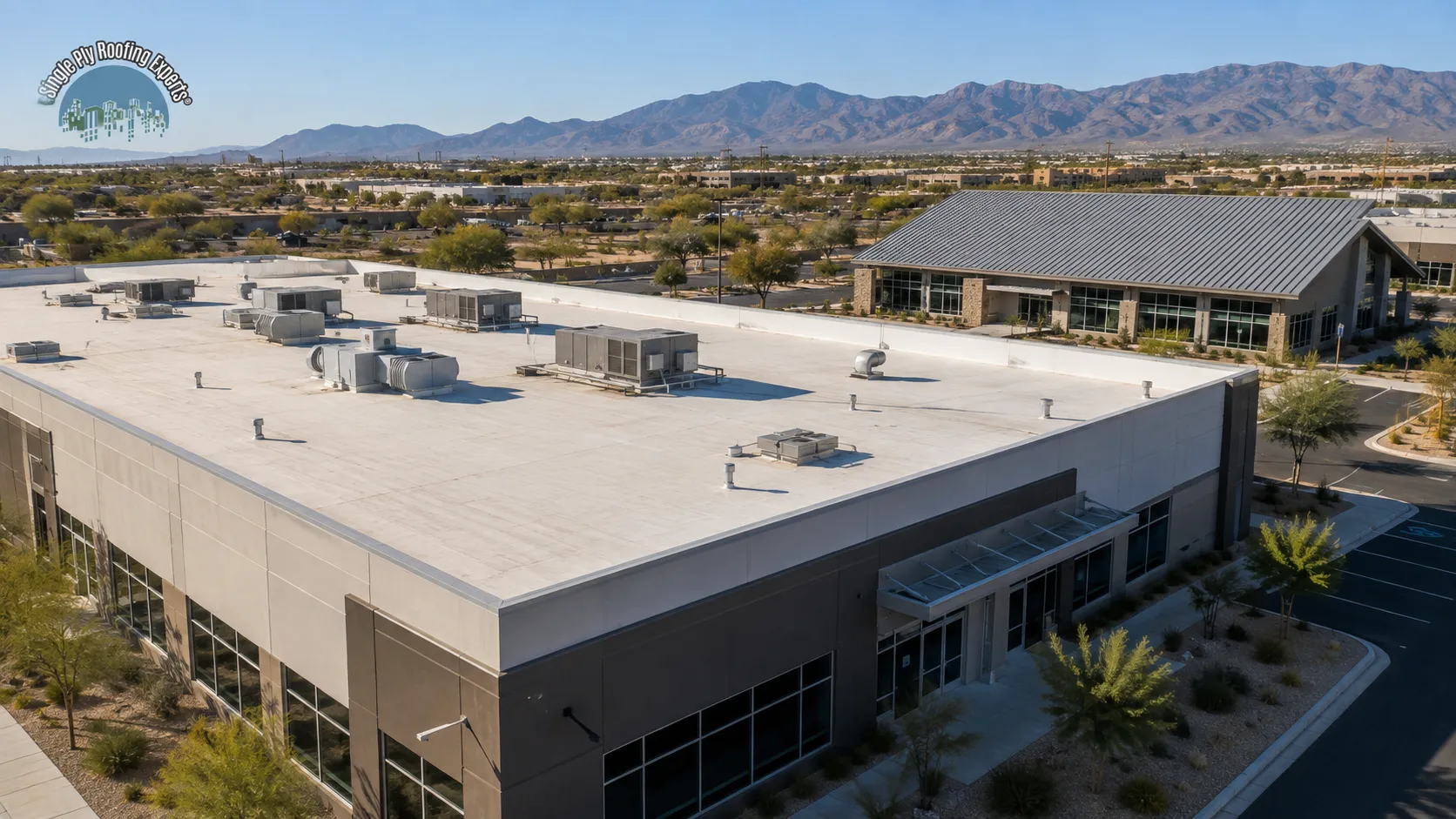
Choosing between a flat roof and a pitched roof for a commercial building is not simply a matter of appearance. Roof geometry affects drainage, structural design, rooftop equipment, maintenance access, solar installation, insulation, construction cost, and how the property can be used over time.
For large warehouses, industrial buildings, retail centers, and many offices, flat and low-slope roofs are common because they work efficiently across large building footprints while creating accessible space for HVAC equipment and other rooftop systems. Pitched roofs can be an excellent fit for smaller commercial properties, hospitality buildings, churches, restaurants, or developments where architectural appearance and rapid natural water runoff are higher priorities.
The right flat roof vs pitched roof decision ultimately depends on the complete building. Size, structure, climate, drainage, equipment, maintenance needs, architecture, and future plans all matter more than choosing one roof shape because it is assumed to be universally better.
What Is the Difference Between a Flat Roof and a Pitched Roof?
At the most basic level, flat roof vs pitched roof describes the slope and geometry of the roof.
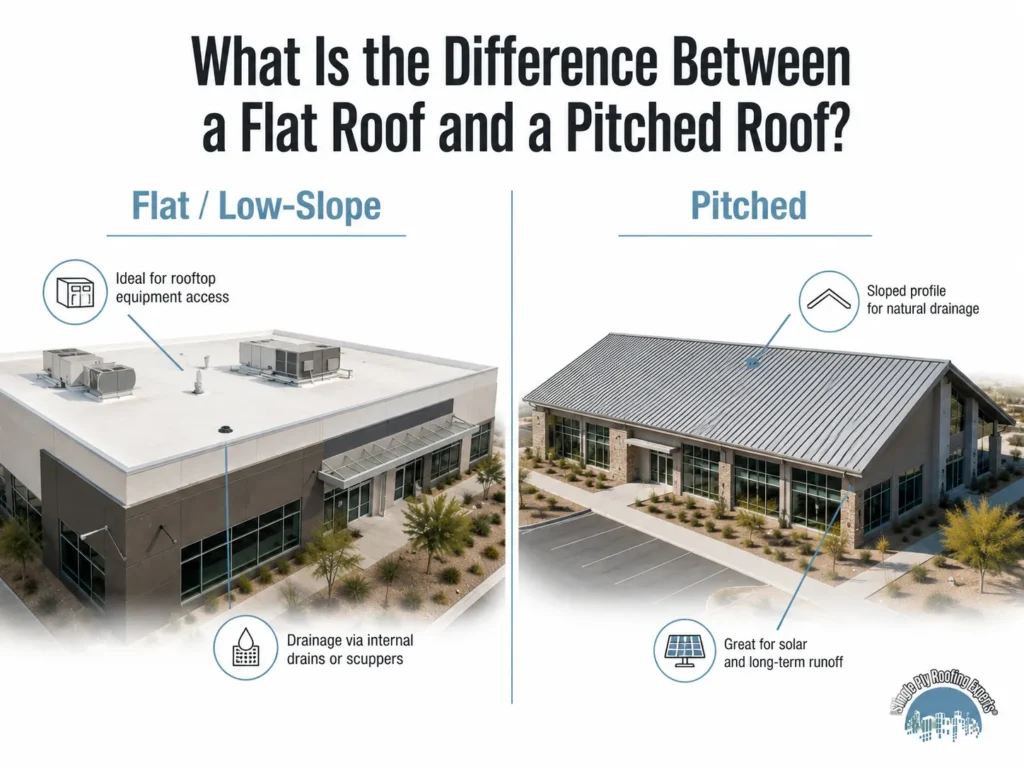
A commercial flat roof is usually a low-slope assembly rather than a perfectly level surface, while a pitched roof rises at a more noticeable angle and naturally directs water toward the perimeter.
What Is a Commercial Flat Roof?
A commercial flat roof usually has enough slope to move water toward designated drainage points even though it appears flat from ground level.
These roofs are commonly finished with low-slope roofing systems such as TPO, PVC, EPDM, modified bitumen, built-up roofing, or compatible coating systems. They are particularly practical on wide buildings because the roof can span a large footprint without creating a tall attic or steep structural profile.
Commercial owners evaluating these assemblies can explore flat roofing services for more information about the roof systems used on low-slope properties.
What Is a Pitched Commercial Roof?
A pitched roof has a visibly greater slope, allowing rainwater to move toward eaves, gutters, and downspouts largely through gravity.
Depending on the property, pitched commercial roofs may use standing-seam metal, shingles, tile, or other roof coverings appropriate to the slope and building design.
They are often selected when architectural appearance is important or where the building footprint makes pitched construction practical.
Why Are Flat Roofs So Common on Commercial Buildings?
One major factor in the flat roof vs pitched roof comparison is building scale.
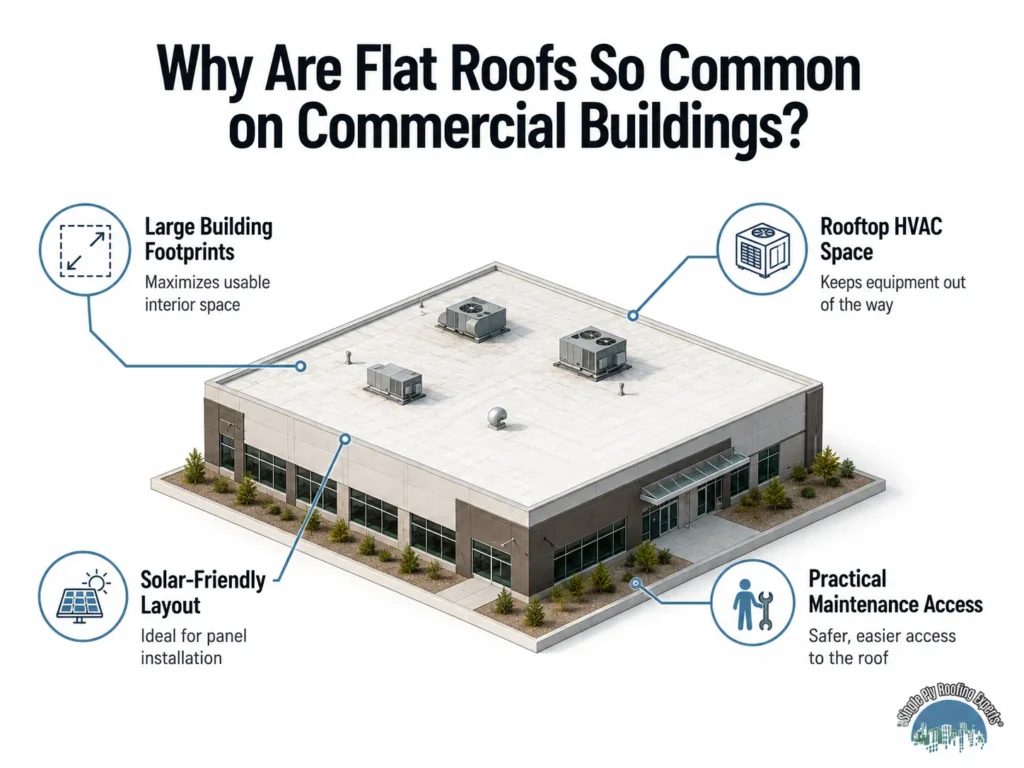
Commercial properties often have much larger footprints than homes, making low-slope construction practical for structural, operational, and rooftop-equipment reasons.
Large Buildings Benefit From Low-Slope Geometry
Imagine placing a steep roof over a very wide warehouse or distribution center. Increasing the slope can create considerably more roof area, additional structural height, and more complicated framing.
A low-slope roof allows designers to cover large interior spaces while keeping the exterior profile relatively compact.
That does not automatically make flat roofing cheaper on every project, but it explains why low-slope assemblies are common across industrial and large commercial construction.
The Roof Becomes Usable Building Space
Commercial flat roofs frequently support HVAC equipment, exhaust systems, communication equipment, solar arrays, service walkways, and other infrastructure.
That rooftop space can help keep large mechanical equipment away from valuable ground-level areas while giving technicians a relatively practical surface from which to service it.
The roof therefore becomes part of the property’s operating infrastructure rather than simply a weather barrier.
Advantages and Disadvantages of Flat and Pitched Commercial Roofs
A useful flat roof vs pitched roof comparison needs to consider both advantages and tradeoffs.
| Factor | Flat / Low-Slope Commercial Roof | Pitched Commercial Roof |
| Drainage | Engineered through slope, drains, scuppers or gutters | Primarily gravity-driven runoff |
| Large building footprints | Highly practical | Can require more framing and roof area |
| HVAC placement | Well suited to rooftop equipment | Usually more difficult |
| Solar layout | Flexible on large open roof areas | Influenced heavily by roof orientation and slope |
| Maintenance access | Generally easier | More difficult as slope increases |
| Architectural visibility | Usually low-profile | Strong visual element |
| Common commercial use | Warehouses, retail, industrial, offices | Restaurants, churches, hospitality, smaller commercial buildings |
Neither geometry eliminates maintenance, drainage, flashing, weather exposure, or installation quality as important performance factors.
Advantages of Commercial Flat Roofs
Flat and low-slope roofs work particularly well over large building footprints and provide convenient space for mechanical systems.
They can accommodate TPO, PVC, EPDM, modified bitumen, and built-up systems, giving owners several approaches for different buildings and operating requirements.
Their relatively accessible surface can also make inspections, HVAC servicing, drainage cleaning, and many repairs more practical than similar work on a steep roof.
Drawbacks of Commercial Flat Roofs
Drainage needs careful design and maintenance because water does not run from the roof as rapidly as it does from a steep slope.
Membrane damage from HVAC technicians, dropped tools, construction work, or repeated foot traffic can also create problems if service routes are not managed.
Drains, scuppers, seams, flashings, and penetrations need periodic attention. A low-slope roof should therefore be treated as a managed building system rather than something that can be ignored after installation.
Advantages and Drawbacks of Pitched Roofs
Pitched roofs benefit from rapid gravity-driven runoff and can create a strong architectural identity for a property. Their visible surface may suit restaurants, hotels, churches, smaller offices, and retail developments where roof appearance contributes to the building design.
The tradeoff is access. As slope increases, inspections, repairs, solar work, and mechanical servicing can become more difficult. A large pitched roof may also require more roof area and structural complexity than a low-slope alternative over the same footprint.
Flat Roof vs. Pitched Roof Cost for Commercial Buildings
Cost is one of the most common flat roof vs pitched roof questions, but there is no useful universal price difference. Building width, structure, roofing material, deck, insulation, drainage, access, height, labor, mechanical equipment, and existing conditions all affect project pricing.
Initial Construction Cost
On a large commercial property, low-slope construction can reduce the need for the tall roof geometry associated with steep pitched structures.
However, the final cost still depends heavily on the roof assembly. Insulation thickness, cover board, membrane choice, attachment, drainage work, rooftop details, and deck type may significantly change a low-slope estimate.
Pitched roofs similarly vary according to framing complexity, slope, metal or other roof covering, gutters, valleys, flashing, and architectural details.
Lifecycle Cost Is More Useful Than Installation Price Alone
An inexpensive roof that requires repeated emergency repairs may ultimately provide poor value.
Owners should consider maintenance access, expected roof traffic, drainage, repairability, future equipment, insulation, and eventual replacement along with installation cost.
A realistic comparison therefore looks at the complete lifecycle of the building instead of treating the lowest initial proposal as the automatic winner.
Drainage on Flat Roof vs. Pitched Roof Systems
Drainage is central to the flat roof vs pitched roof discussion. Pitched roofs use gravity very efficiently, while commercial flat roofs depend more heavily on engineered slope and correctly positioned drainage components.
How Commercial Flat Roofs Drain
A low-slope roof can direct water toward interior drains, scuppers, perimeter gutters, or combinations of these systems.
Tapered insulation may also be designed to create or improve slope where needed. Crickets and other tapered areas can help move water around rooftop equipment and toward drainage points.
The important distinction is that a properly designed commercial roof should not simply be treated as a level surface that holds water.
For more technical background on roof slope and drainage design, see the GSA roofing and drainage guidance.
Does a Pitched Roof Always Drain Better?
A steeper roof naturally sheds water faster, but roof slope alone does not guarantee trouble-free drainage.
Gutters can clog, valleys can leak, flashing can deteriorate, and concentrated runoff can create problems at the building perimeter.
The better question is whether the complete drainage system is correctly designed and maintained for the property.
Maintenance and Lifespan: Flat Roof vs. Pitched Roof
Maintenance is another important flat roof vs pitched roof consideration, but roof shape does not determine service life on its own. Material, installation, drainage, climate, maintenance, roof traffic, and repairs all influence how long a roofing system performs.
Flat-Roof Maintenance
Commercial low-slope roofs benefit from routine inspection of membranes, seams, penetrations, HVAC curbs, flashings, drainage areas, and previous repairs.
One advantage is accessibility. Technicians can usually examine more of a low-slope roof directly than they could on a steep roof.
The downside is that the same accessible surface often receives more service traffic, increasing the importance of membrane protection.
Pitched-Roof Maintenance
Pitched roofs may naturally shed more water and debris, but they still need inspection of flashings, valleys, gutters, fasteners, panels, shingles, penetrations, and transitions.
Access can become more complicated and may require additional safety equipment or specialized methods.
There is therefore no reliable rule that pitched roofing automatically lasts longer than flat roofing.
HVAC and Solar on Flat Roof vs. Pitched Roof Buildings
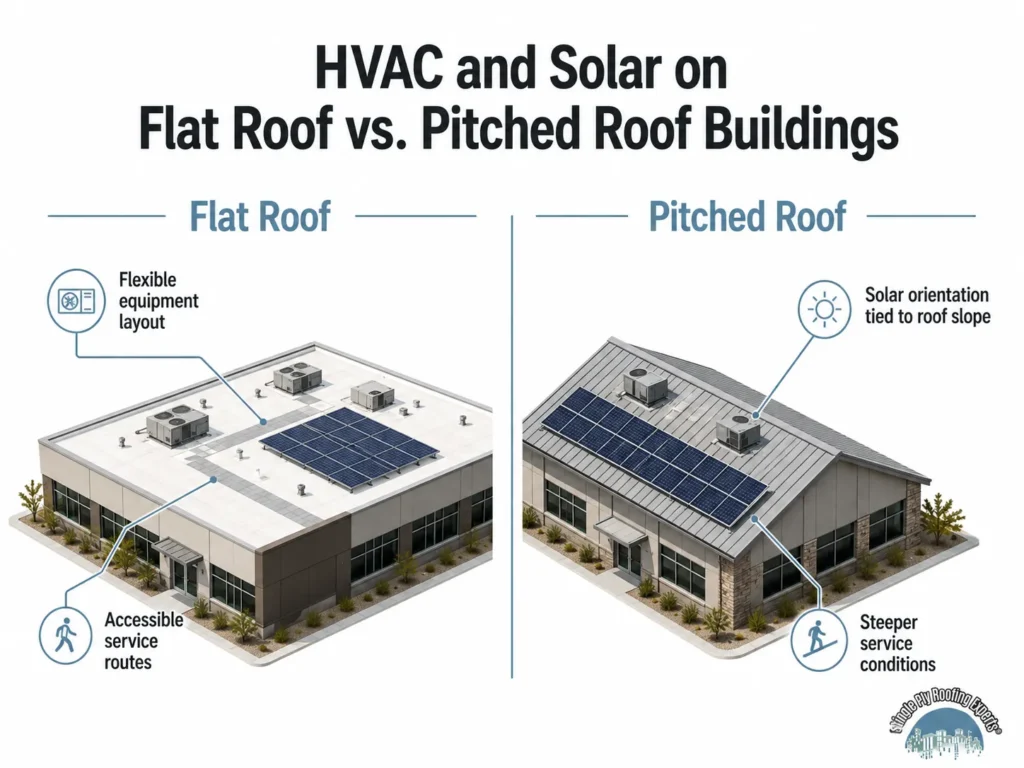
For many commercial owners, the most important flat roof vs pitched roof difference is not visible from the ground. It is how easily the roof can support and provide access to mechanical equipment, solar arrays, and future building systems.
HVAC and Mechanical Equipment
Large commercial buildings often have substantial rooftop HVAC systems.
Low-slope roofs provide practical areas for equipment curbs, service clearances, piping, exhausts, and technician access. The roofing system must still be correctly flashed and protected from repeated maintenance traffic.
Installing and servicing similar equipment on a steep roof can be considerably more difficult.
Commercial Solar Panels
Flat roofs can offer flexible solar layouts because racks can be designed around roof orientation, HVAC equipment, drainage, and service routes.
Pitched roofs can also support solar, but panel orientation is more directly tied to the slope and direction of the existing roof plane.
In either case, the roof condition and structural capacity should be evaluated before a long-term solar system is installed.
Energy Efficiency and Roof Geometry
Energy performance should not be reduced to a simple flat roof vs pitched roof verdict. Insulation, air sealing, roof color, membrane properties, interior HVAC systems, climate, and the complete building envelope usually matter more than geometry alone.
Insulation Matters More Than Shape Alone
A well-insulated low-slope roof can perform very differently from a poorly insulated low-slope roof, just as two pitched roofs can have very different thermal performance.
Commercial roof replacement also creates an opportunity to review insulation and address deficiencies rather than focusing solely on the exposed membrane.
Reflective Commercial Roofing
Light-colored and reflective low-slope membranes are widely available for commercial roofing and may help reduce solar heat absorption where appropriate for the climate and building.
The U.S. Department of Energy provides additional information on cool roof selection and commercial low-slope roofing.
Reflectivity should still be evaluated together with insulation, HVAC efficiency, local climate, and the building’s actual operating conditions.
Which Roof Type Works Best for Different Commercial Properties?
Building use often provides a clearer flat roof vs pitched roof answer than a generic pros-and-cons list. Different properties place very different demands on roof access, mechanical equipment, appearance, structure, and maintenance.
Warehouses, Industrial Buildings, and Retail Centers
Large warehouses and industrial facilities commonly benefit from low-slope construction because of their wide footprints and extensive mechanical infrastructure.
Retail centers also frequently use flat roofs to accommodate multiple tenant HVAC systems while keeping mechanical equipment less visible from the street.
For properties like these, the roof’s accessibility and ability to accommodate future equipment can be as important as the membrane itself.
Offices, Hospitality, Restaurants, and Mixed-Use Buildings
Office buildings may use either configuration depending on architecture and mechanical needs.
Hotels and restaurants may use pitched roof sections prominently where appearance matters while retaining low-slope sections for equipment.
Mixed-roof designs are therefore common. The choice does not always have to be entirely flat or entirely pitched.
New Construction vs. Existing Commercial Buildings
The flat roof vs pitched roof decision changes considerably depending on whether the property is still being designed or already exists. New construction offers freedom to select roof geometry from the beginning, while an existing building carries structural and mechanical conditions that can make major changes more complicated.
New Construction Offers More Flexibility
During design, architects and engineers can coordinate roof shape with structural spans, HVAC placement, drainage, solar planning, architecture, and energy requirements.
That makes it possible to compare flat and pitched alternatives before the structure is committed to either geometry.
Existing Buildings Usually Favor Improving What Is Already There
Converting an existing commercial flat roof into a steep pitched roof may involve new framing, structural changes, rooftop-equipment relocation, altered drainage, permits, and architectural work.
In many cases, a more practical question is whether the existing low-slope roof can be improved through better insulation, drainage, membrane selection, or replacement.
How Roof Geometry Affects Future Expansion and Building Use
Future planning is an overlooked part of the flat roof vs pitched roof decision. Commercial buildings often change over time, and roof geometry can influence how easily new HVAC systems, solar arrays, exhaust equipment, communications systems, or additions can be incorporated.
Flat Roofs Offer Flexible Rooftop Layouts
A large low-slope roof can provide flexible locations for future mechanical or energy equipment, provided structural capacity, drainage, access, and waterproofing are considered.
That flexibility can be valuable for warehouses, manufacturing buildings, multifamily properties, and growing commercial facilities.
Pitched Roofs Can Limit Rooftop Equipment Options
Pitched roofs can still accommodate equipment, but the slope may make placement, platforms, access, and future servicing more complicated.
If significant rooftop infrastructure is anticipated, that operational requirement should be considered before the roof geometry is finalized.
Flat Roof vs. Pitched Roof in California, Arizona, and Nevada
Climate matters when evaluating flat roof vs pitched roof systems in California, Arizona, and Nevada, but none of these states should be treated as having one uniform roofing environment. Coastal exposure, desert heat, elevation, wind, seasonal storms, and local code requirements can vary considerably.
Heat and UV Exposure
Intense solar exposure can place significant thermal stress on roofing materials, particularly across large commercial roof areas.
Roof-system selection should account for UV exposure, insulation, membrane performance, rooftop equipment, and the building’s cooling requirements.
Rainfall Still Makes Drainage Important
Even properties in relatively dry regions need dependable drainage when storms occur.
Drains, scuppers, gutters, overflow provisions, and roof slope need to remain functional because heavy rainfall can expose drainage weaknesses quickly.
The correct system should therefore be selected for the actual property and local conditions rather than broad assumptions about the Southwest.
Repair, Recover, Replace, or Change Roof Geometry?
For owners of existing properties, flat roof vs pitched roof may not be the most important decision. The real question may be whether the current roof needs targeted repair, a suitable recover system, full replacement, drainage improvements, or a much larger structural redesign.
When Repair May Be Enough
Localized membrane damage, flashing defects, punctures, or isolated seam issues may sometimes be repaired when the rest of the roof remains serviceable.
A problem in one area does not automatically justify rebuilding the entire roof.
When Replacement Makes More Sense
Replacement becomes more relevant when deterioration is widespread, leaks continue in multiple areas, insulation is wet, the deck requires repair, or the roof has accumulated extensive problems.
A professional roof inspection can help separate a repairable condition from one that requires a broader roofing plan.
Should You Convert a Flat Roof to a Pitched Roof?
Conversion is technically possible on some properties, but it can become a major building project rather than a straightforward roofing project.
Structural framing, height, mechanical equipment, drainage, architecture, and local requirements may all change.
For many commercial owners, improving the existing low-slope assembly may be more practical than rebuilding the roof geometry, but the answer needs to come from the specific building.
Frequently Asked Questions About Flat Roof vs. Pitched Roof Commercial Buildings
The following flat roof vs pitched roof questions address the issues commercial building owners most commonly encounter when evaluating roof geometry, maintenance, and replacement.
Which Is Better for a Commercial Building, Flat or Pitched?
Neither is universally better. Large commercial properties often favor flat or low-slope roofs because of building footprint, mechanical equipment, access, and solar flexibility. Pitched roofs can be attractive for smaller or architecture-driven properties.
Are Commercial Flat Roofs Actually Flat?
No. Proper commercial flat roofs normally include slope designed to move water toward drains, scuppers, gutters, or other drainage points.
Are Flat Roofs Cheaper Than Pitched Roofs?
They can be economical for large commercial footprints, but final cost depends on structure, insulation, membrane, drainage, access, labor, and project conditions.
Which Roof Is Easier to Maintain?
Low-slope roofs are usually easier to physically access, although they require regular attention to drainage, membrane condition, flashing, and rooftop traffic.
Which Roof Drains Better?
Pitched roofs shed water rapidly through gravity. Flat commercial roofs use engineered slope and drainage. Either system can manage water effectively when correctly designed and maintained.
Which Roof Lasts Longer?
Roof geometry alone does not determine lifespan. Material, installation quality, climate, drainage, maintenance, traffic, and repairs all influence service life.
Can Solar Panels Be Installed on Both?
Yes. Solar can be installed on both roof types when structural capacity, roof condition, mounting design, drainage, and access are properly evaluated.
Can a Commercial Flat Roof Be Converted to a Pitched Roof?
Potentially, but the project may require major structural, mechanical, architectural, and permitting changes. A building-specific evaluation is necessary.
Conclusion
The most useful way to think about flat roof vs pitched roof is not to ask which shape wins in a generic comparison. The better question is which complete roofing assembly fits the building’s structure, operations, drainage, mechanical equipment, solar plans, maintenance program, climate, and long-term ownership goals.
Large warehouses, industrial facilities, retail centers, offices, and multifamily properties often benefit from low-slope roofing because it works efficiently across wide footprints and provides practical space for mechanical equipment and maintenance. Other commercial buildings may benefit from pitched sections where architectural appearance, roof visibility, or building geometry makes them appropriate.
For an existing property, changing roof geometry may not even be necessary. Improving drainage, insulation, membrane performance, flashing, or rooftop protection may solve the underlying problem without rebuilding the structure.
Single Ply Roofing Experts specializes in flat and low-slope roofing systems and can help commercial property owners evaluate existing membrane condition, drainage, insulation, repair needs, and replacement options before committing to a major roofing project. Learn more about our commercial roofing services if you manage a warehouse, retail center, multifamily property, office, industrial facility, or another commercial building.