The smartest way to cut commercial roof costs is not to buy the cheapest roof; It is to prevent expensive problems from becoming urgent.
A low bid can become an expensive roof if the contractor misses wet insulation, installs the wrong system for the building, underestimates drainage problems, uses weak details around penetrations, or leaves the property owner paying repeatedly for leaks and disruption.
For building owners, facility managers, asset managers, HOAs, developers, and commercial real estate teams, the real objective should be to reduce total roof lifecycle cost. The most effective strategy is therefore straightforward: inspect earlier, plan further ahead, buy the correct system, and hold the contractor accountable to a clearly defined scope.
Start With a Roof Condition Assessment Before Setting the Budget
A roof that looks acceptable from the surface can contain wet insulation, concealed deterioration, or recurring failures that make continued patching a poor investment. Unexpected wet insulation is one of the conditions that can expand a reroofing scope after work begins.
Where appropriate drone scanning or infrared scanning can help the roofing team better understand conditions below the membrane. That helps cut commercial roof costs in two ways: the owner receives a more realistic budget before mobilization, and bidders are more likely to price comparable work.
Choose Your Commercial Roofing Contractor Wisely
Commercial Roofing Contractor selection has a direct effect on whether you actually cut commercial roof costs or simply move expenses into the future.
Verify the Contractor’s State License
Do not rely on a logo, truck, proposal template, or claim that a company is “certified.” Verify the license required for the project’s jurisdiction and confirm that the contractor is appropriately insured for the work being proposed. For transparency, Single Ply Roofing Experts currently publishes California License #1051442 and Arizona License #347542..
The point is not paperwork for its own sake. Commercial roof replacement exposes owners to safety, waterproofing, operational, and contractual risk. A qualified contractor should be prepared to document who they are and the type of work they are authorized to perform.
Choose a Contractor That Can Provide an NDL Warranty When the Project Qualifies
An NDL, or No Dollar Limit, warranty can be valuable on an eligible commercial roof because manufacturer-backed warranty structures may provide broader protection than a basic contractor workmanship warranty.
But do not simply ask, “Do you offer a warranty?”
Ask:
What warranty applies to this exact assembly? Who issues it? What is the term? What inspections are required? What maintenance obligations remain with the owner? Which exclusions apply?
Single Ply Roofing Experts currently advertises roofing systems with up to 30-year NDL warranty options.
Ask for Same-Size and Similar-Complexity Project Case Studies
A contractor may have commercial experience without having experience that resembles your project. Ask for previous work involving similar square footage, property type, membrane, rooftop equipment, tear-off requirements, tenant conditions, drainage complexity, or logistical constraints.
Single Ply Roofing Experts has done approximately 1,000,000 square feet of full roof demolition, reroofing, and maintenance work. Our projects include Walmart Expansion, Tucson, Starbucks, Costa Mesa, Toyota/Hyundai, Escondido, and Pechanga Resort Casino. That is the type of proof commercial owners should request; not vague statements about “thousands of successful projects,” but relevant examples showing the contractor has handled real operational scale.
Compare Lifecycle Cost, Not Just the Lowest Roofing Bid
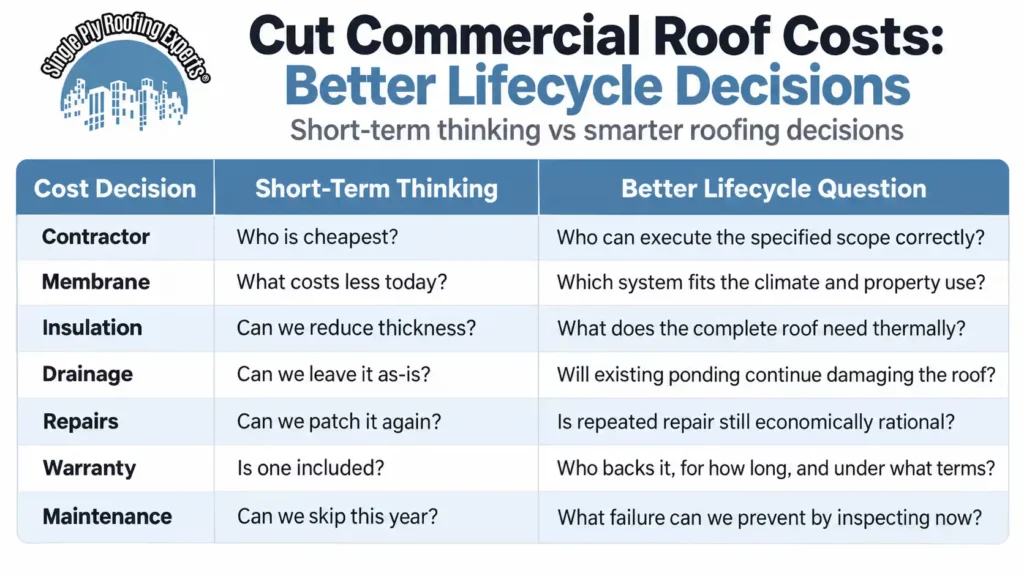
If your objective is to cut commercial roof costs, the lowest initial proposal is not necessarily the lowest-cost solution. Roofing bids should be compared based on what is actually included, what problem the system solves, and how much work the owner is likely to fund over the roof’s useful service period.
Normalize Proposals Before Choosing
Two contractors can submit dramatically different prices because they are proposing dramatically different projects. One may include wet-insulation replacement allowances, cover board, tapered insulation, edge work, drain modifications, flashing reconstruction, permits, warranty inspections, and detailed closeout. Another may exclude half of those items. Before treating one bid as a “saving,” convert proposals into a comparable scope. A cheaper number that excludes necessary work is not necessarily a lower cost. It may simply be an incomplete budget.
Choose Repair, Restoration, Recover, or Replacement for the Actual Roof Condition
Property owners can cut commercial roof costs significantly by choosing the correct level of intervention. Automatically replacing every leaking roof wastes capital. Repeatedly repairing a roof that has already failed wastes it too.
Repair When the Problem Is Localized
Targeted repair can make sense when defects are isolated and the surrounding roof remains functional. Examples may include a puncture, localized seam failure, damaged flashing, or an isolated penetration problem. The repair needs to address the cause rather than repeatedly sealing the visible symptom.
Evaluate Restoration When the Existing Roof Is Still a Suitable Candidate
Coatings and restoration systems can sometimes extend the useful life of an existing roof, improve reflectivity, and postpone tear-off.
They are not magic liquid replacements for failed roofing. The existing membrane, adhesion, moisture, drainage, flashings, substrate, and structural conditions should be evaluated first. A restoration system installed over an unsuitable roof can turn an apparent saving into another capital expense.
Replace When Continued Repair Stops Making Financial Sense
When leaks occur across multiple areas, insulation is extensively wet, decking is deteriorated, major drainage work is required, or the roof has become a recurring operational problem, replacement may produce a better lifecycle result. Cut commercial roof costs by spending at the right time, not by delaying unavoidable work until an emergency chooses the schedule for you.
Pay Attention to Energy Savings When Choosing the Roofing Material
The opportunity to cut commercial roof costs continues after installation. Roof membrane color, insulation, air leakage, moisture, and building HVAC performance can all influence operating expense, particularly across large conditioned commercial properties.
Evaluate Reflective Roofing in Hot Climates
Reflective TPO and PVC membranes can be useful options where solar exposure and cooling demand make roof heat gain important.
Single Ply Roofing Experts currently identifies reflective single-ply materials among the energy-efficient roofing options it installs.
The important word is evaluate. A white membrane does not automatically guarantee a particular energy saving. Climate, insulation, HVAC efficiency, building usage, roof area, interior conditions, and energy prices all influence the result. For commercial buildings in California, Arizona, and Nevada, that analysis can be especially relevant because roof surfaces may experience intense solar exposure for large portions of the year.
Do Not Ignore Insulation During Reroofing
The membrane is only the top layer of the system. A replacement project may provide an opportunity to evaluate wet insulation, thermal resistance, tapered insulation, and the continuity of the roof assembly. If the building has inadequate insulation or persistent drainage issues, replacing only the membrane may miss a valuable opportunity to improve the roof’s long-term performance.
Fix Drainage Problems While the Roof Is Already Open
Drainage is one of the most expensive problems to ignore if your goal is to cut commercial roof costs. Repeated ponding can stress membranes, contaminate repair areas, accelerate deterioration around details, and turn clogged or ineffective drains into interior water events.
Use the Reroofing Project to Correct Chronic Low Areas
If the existing roof consistently holds water in the same locations, document those areas before removal. The cheapest moment to discuss drainage is often while the roof is already being designed and rebuilt, not two years later when the new membrane is showing the same ponding pattern as the old one.
Perform Roof Maintenance Before the High Season Starts
Preventive maintenance is one of the most controllable ways to cut commercial roof costs. The objective is to find inexpensive defects while they are still inexpensive, before severe heat, rain, wind, or seasonal storms turn them into active leaks and emergency calls.
Schedule the Inspection Before the Weather Tests the Roof
The right “high season” depends on the property. In Arizona, owners may be planning around extreme summer heat and monsoon conditions. In parts of California, seasonal rainfall may be the more urgent concern. Nevada properties can face intense UV exposure, heat, wind, and localized storm conditions. Do not wait for the first major weather event to discover that a drain is blocked or flashing has opened.
Single Ply Roofing Experts offers commercial roof maintenance services that focus on membranes, seams, flashings, drainage, ponding areas, inspections, and preventive repairs.
Keep Rooftop Service Traffic Under Control
Commercial roofs are workplaces. HVAC contractors, solar crews, plumbers, electricians, communications technicians, and other vendors may all cross the membrane. A dropped tool or careless equipment movement can create a puncture that has nothing to do with the original roof installation. Use defined access paths where appropriate, document rooftop work, and inspect the membrane after major mechanical projects. That small operational discipline can cut commercial roof costs that otherwise appear months later as mysterious leaks.
Reduce Business Disruption, Not Just Roofing Labor
The invoice from the roofer is only one component of commercial roofing cost. A project can also affect customers, tenants, inventory, employees, production, parking, deliveries, noise-sensitive operations, and HVAC service.
A professional commercial contractor should be able to explain how the project will move across the building. Ask about material staging, dumpsters, cranes, loading zones, roof access, tear-off areas, temporary weather protection, tenant communication, noisy work, and daily watertightness. A well-managed project can reduce indirect costs by helping the building continue operating while work progresses.
Reduce Change Orders With Better Preconstruction Planning
Another effective way to cut commercial roof costs is to minimize avoidable surprises between contract signing and project completion.
Not every change order is preventable. Hidden deck deterioration, concealed moisture, and undocumented previous construction can only be confirmed once portions of the assembly are exposed.
Define How Unknown Conditions Will Be Handled
Before construction, establish what happens if crews discover wet insulation, corroded steel deck, deteriorated wood, unexpected roof layers, or previously concealed damage. The contract should explain how the condition is documented, priced, approved, and incorporated into the project.
Do Not Replace a Roof Without Asking What Caused the Old One to Fail
A replacement roof can still inherit old problems. To genuinely cut commercial roof costs, identify whether recurring failures were caused by membrane age, bad drainage, poor flashing, equipment traffic, installation errors, incompatible repairs, building movement, excessive moisture, or another condition.
The best commercial reroofing projects do not simply put new material where old material used to be. They use the replacement opportunity to eliminate known weaknesses.
How Single Ply Roofing Experts Helps Property Owners Control Roofing Cost
Single Ply Roofing Experts focuses on commercial flat and low-slope roof systems in California, Arizona, and Nevada, with services spanning inspections, repairs, maintenance, single-ply systems, waterproofing, and replacement.
For an owner trying to cut commercial roof costs, the question isn’t “Which membrane should I buy?”
It must be:
What condition is the roof in? Why is it failing? Can it be repaired? Is moisture present? Is drainage working? What does the building need operationally? Which roof assembly makes financial sense over its lifecycle?
FAQs About How to Cut Commercial Roof Costs
What Is the Best Way to Cut Commercial Roof Costs?
The best way isn’t choosing the lowest bid; It starts with inspection and preventive maintenance. Early detection gives you more options and can prevent minor defects from becoming emergency repairs or premature replacements.
Can Commercial Roof Maintenance Really Save Money?
Preventive maintenance can identify small membrane, flashing, seam, or drainage problems before they create larger water intrusion and repair costs.
Should I Repair or Replace My Commercial Roof?
Repair is often appropriate for isolated defects on an otherwise serviceable roof. Replacement deserves consideration when deterioration, wet insulation, repeated leaks, drainage problems, or recurring repairs are widespread.
What Is an NDL Roof Warranty?
NDL means No Dollar Limit. It is a type of manufacturer-backed warranty available on qualifying roof systems. Terms, inspections, eligibility, exclusions, and maintenance obligations vary by manufacturer and assembly.
How Often Should a Commercial Roof Be Inspected?
Inspection frequency should reflect roof age, condition, climate, warranty requirements, rooftop activity, and previous problems. Inspections before and after major weather periods can be particularly valuable.