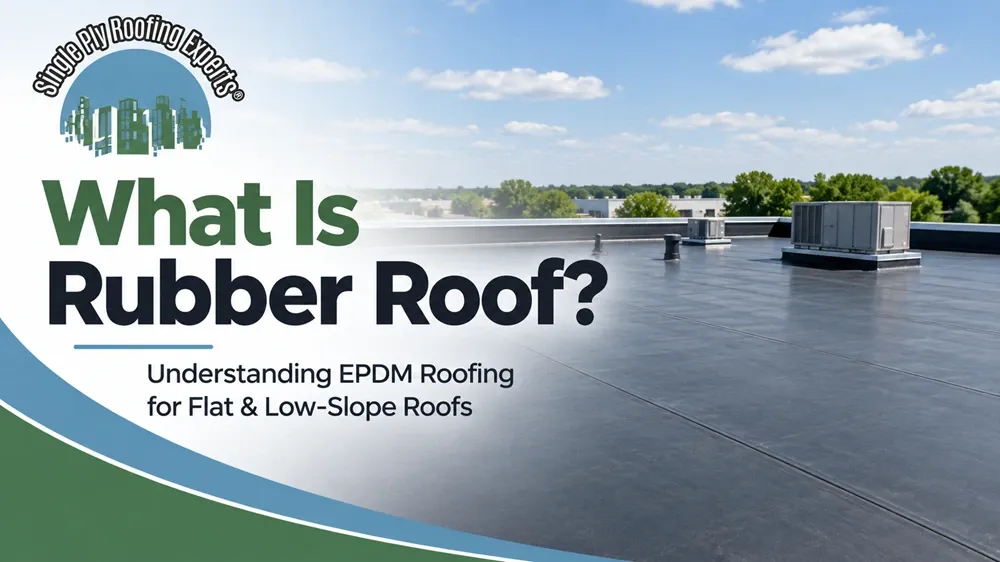
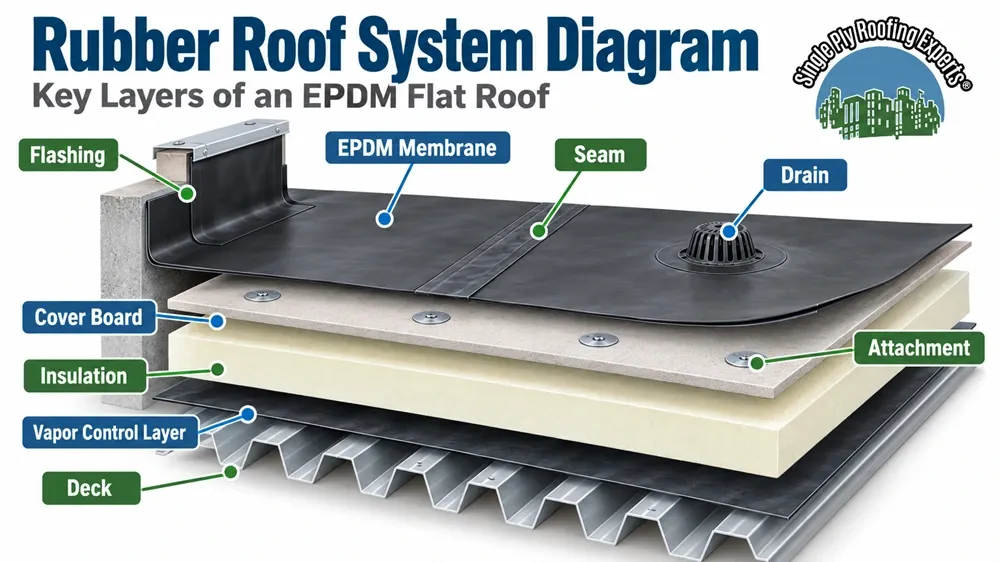
A rubber roof system uses a single-ply membrane primarily on flat and low-slope buildings. In commercial roofing, the term usually refers to EPDM, short for ethylene propylene diene terpolymer. It provides a flexible, weather-resistant surface, but its performance depends on the entire assembly: deck, vapor control, insulation, cover board, attachment, membrane, flashing, and drainage.
For facility managers, that distinction matters. Buying a rubber roof system based only on membrane thickness or price per square foot can leave expensive risks unexamined. The correct question is whether the complete assembly fits the building, climate, operations, deck, rooftop traffic, and capital plan.
What Is a Rubber Roof System?
A rubber roof system is a complete low-slope roofing assembly finished with an EPDM membrane. The membrane can be fully adhered, mechanically attached, or ballasted. Seams are joined with compatible adhesive or formulated seam tape.
The attachment method is not a minor specification. A fully adhered system limits membrane movement and can suit complex roof layouts. A mechanically attached rubber roof can reduce adhesive use but requires a fastening pattern engineered for the deck and anticipated wind pressures. A ballasted assembly uses stone or pavers to hold the membrane in place, adding structural weight and changing how technicians reach concealed areas.
On an occupied facility, we also assess odor restrictions, equipment vibration, roof access, shutdown limitations, drainage, and future solar or HVAC work. Those operational factors often determine which rubber roof system is practical.
What Is a Rubber Roof Made Of?
A rubber roof is made primarily from EPDM, a synthetic rubber whose principal polymer ingredients are ethylene, propylene, and a diene component. ASTM D4637/D4637M covers EPDM sheet intended for exposed single-ply roofing and classifies nonreinforced, internally reinforced, and fabric-backed membrane types.
Commercial sheets are commonly supplied in black, white, or gray and in several thicknesses. The EPDM Roofing list includes 45-, 60-, and 90-mil products, as well as sheet widths up to 50 feet. Wider sheets can reduce field-seam length, although rooftop geometry, lifting logistics, and crew control still affect the best layout.
The membrane is only the exposed layer. A rubber roof system may also include primers, seam tape, flashing, adhesives or fasteners, insulation, cover board, and vapor-control components. Every material must be approved as compatible within the specified assembly.
Rubber Roofing Applications
A rubber roof system is principally applied to low-slope commercial roofs, additions, canopies, and other surfaces where water cannot shed as it does from a steep roof.
New Construction
In new construction, a rubber roof system can be designed together with the deck, insulation, drainage, wind-uplift requirements, and rooftop equipment. This gives the design team the best opportunity to simplify penetrations and establish service paths before conflicting trades reach the roof.
Commercial Re-Roofing
For re-roofing, EPDM can provide a durable replacement when moisture testing, deck inspection, and code review support the proposed assembly. The existing roof should not simply be covered without identifying wet insulation, trapped moisture, inadequate slope, or deteriorated substrate.
Repair and Restoration
An aging rubber roof may remain repairable when the field membrane is sound and deficiencies are localized. Compatible repairs can address seams, flashing, punctures, and certain detail failures. A condition assessment should distinguish isolated defects from widespread wet insulation or systemic drainage problems before money is committed.
What Buildings Does a Rubber Roof Suit?
A rubber roof system suits many warehouses, manufacturing plants, offices, retail properties, schools, multifamily buildings, and institutional facilities with flat or low-slope roofs. Suitability depends more on roof conditions and operational demands than on the building’s category.
A rubber roof system is often a strong candidate where large, open roof areas can use broad sheets efficiently, long-term repairability matters, and the owner can control rooftop access. It may require added protection around service routes, frequently maintained equipment, dropped tools, grease discharge, or sharp debris.
Color also deserves a building-specific decision. The U.S. Department of Energy says solar reflectance, retained reflectance, and thermal emittance are key properties when selecting a roof to reduce cooling load. Actual energy savings vary with climate, insulation, HVAC efficiency, and operating conditions. White EPDM may support a reflectivity objective, while black EPDM may fit other climate or design priorities.
Life Expectancy of a Rubber Roof
The life expectancy of a rubber roof system can extend for decades when the assembly is properly designed, installed, inspected, and maintained. In 2026, the EPDM Roofing Association reported an expected service life of 38 years based on field evidence, laboratory findings, and practitioner input. That figure is a planning reference, not a warranty or promise for every roof.
What Shortens Service Life?
Poor flashing, open seams, chronic ponding, uncontrolled foot traffic, incompatible materials, punctures, and delayed repairs can shorten the service life of a rubber roof system. The National Roofing Contractors Association identifies abuse, design deficiencies, improperly installed or deteriorated flashing, and seam failure among likely sources of leaks in ballasted EPDM assemblies.
What Extends Service Life?
Good drainage, correct installation, documented inspections, clean service paths, compatible repairs, and fast responses to damage help preserve a rubber roof. Facility teams should inspect the roof after major storms and rooftop contractor activity while following the manufacturer’s maintenance and warranty requirements.
Uses of Rubber Roofing
The primary use of a rubber roof system is to create the weatherproofing layer on low-slope roofs, but EPDM also supports certain vertical transitions, perimeter details, penetrations, and restoration work within an approved system. It should be treated as an engineered assembly, not a roll of waterproof material applied independently.
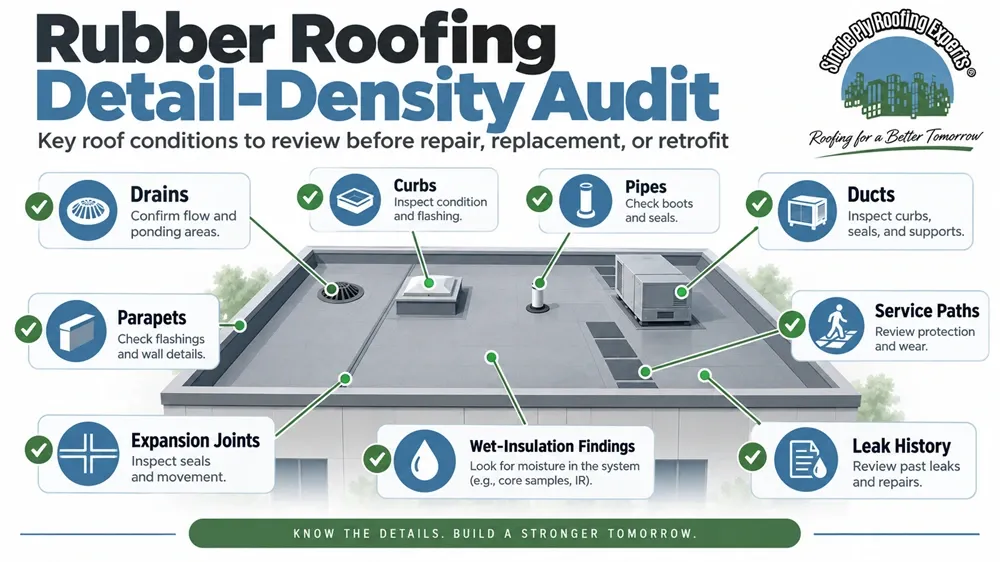
The most useful procurement approach is a detail-density audit. Count and classify drains, curbs, pipes, ducts, expansion joints, parapets, and equipment service zones before comparing bids. A smaller but congested roof can carry more installation and leak risk than a much larger open warehouse roof. This explains why area-only pricing often misrepresents lifecycle exposure.
For portfolio planning, record each detail type, known leak history, wet-insulation findings, attachment method, membrane thickness, installation year, warranty status, and roof-access event. That record makes future rubber roof system inspections faster and capital forecasts more defensible.
Rubber Roof FAQs
Is Rubber Roofing Expensive?
Rubber roofing is not inherently expensive or inexpensive. Installed cost depends on roof size, tear-off requirements, deck condition, insulation, attachment, access, wind design, details, labor market, and warranty scope. Facility managers should compare lifecycle cost, exclusions, and assembly equivalence rather than selecting a rubber roof from price per square foot alone.
Is Rubber Roof Membrane Waterproof?
Yes, a rubber roof membrane is designed to serve as a waterproofing layer when correctly installed as part of a complete assembly. The sheet alone does not make a roof reliably watertight. Seams, penetrations, flashings, edges, drains, compatible accessories, and workmanship determine whether water stays outside during actual operating conditions.
What Is Rubber Roofing Material?
Rubber roofing material usually means EPDM. In a commercial rubber roof system, the membrane works with insulation, cover board, fasteners or adhesive, seam materials, flashings, and drainage components rather than functioning as a stand-alone product.
What Is Rubber Roofing Used For?
Rubber roofing is used mainly as the exposed weatherproofing membrane on flat and low-slope commercial roofs. It can serve warehouses, offices, retail buildings, multifamily properties, schools, and industrial facilities.
What Is the Life Expectancy of a Rubber Roof?
The life expectancy of a rubber roof is commonly measured in decades, but the actual result depends on design, installation, climate, drainage, traffic, and maintenance. Industry research published in 2026 identifies 38 years as an expected service-life reference for properly designed, installed, and maintained EPDM, not a guarantee for every building.