
Commercial flat roofs face a difficult combination of environmental stresses. High temperatures, intense UV exposure, heavy rain, strong winds, hail, standing water, rapid temperature changes, and rooftop traffic can all affect a roof differently. A roofing system that performs well against one hazard may require different detailing or protection to perform against another.
That is why choosing the best commercial flat roofing solutions for harsh weather conditions should not begin by asking which membrane is universally strongest. The better question is which complete roof assembly best matches the building, climate, roof deck, drainage, business operations, and specific environmental exposure.
TPO, PVC, EPDM, modified bitumen, built-up roofing, and roof coatings can all play a role in harsh-weather roofing. Their performance depends heavily on membrane specification, attachment, insulation, cover boards, flashing, edge details, drainage, installation quality, and ongoing maintenance.
For commercial owners in California, Arizona, and Nevada, the challenge is particularly varied. Extreme heat and solar exposure may dominate one property, while another may face wind, seasonal storms, drainage problems, coastal exposure, or frequent rooftop maintenance. The roof should be designed around those actual conditions rather than a generic product recommendation.
What Does “Harsh Weather” Mean for a Commercial Flat Roof?
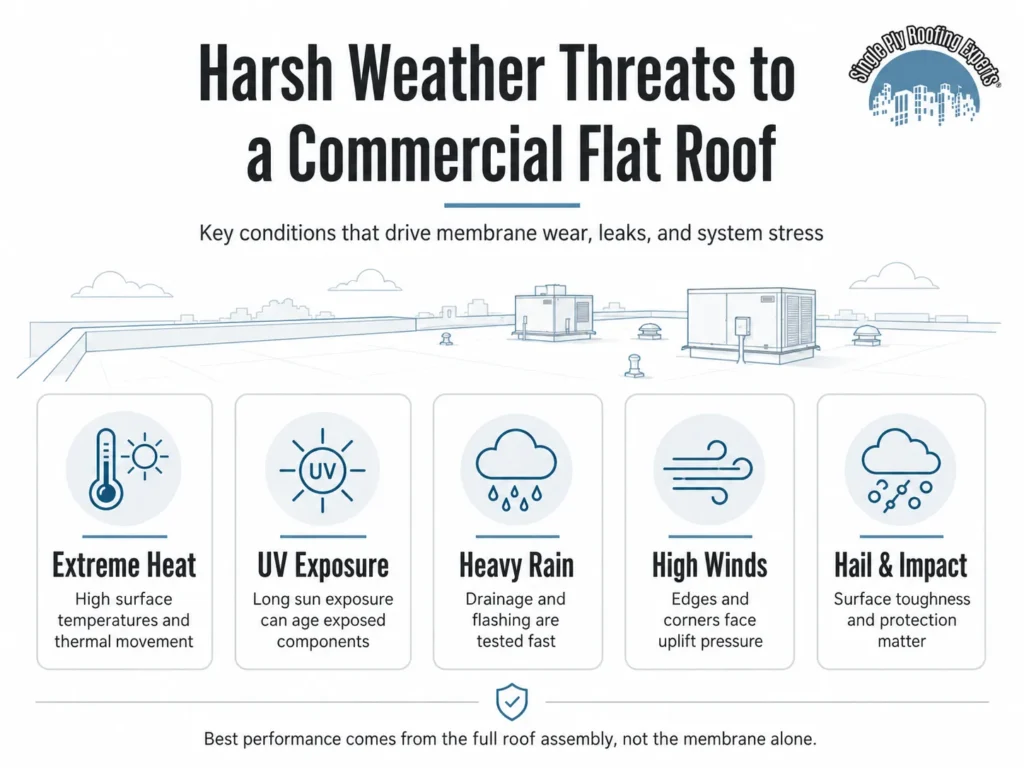
When evaluating the best commercial flat roofing solutions for harsh weather conditions, the first step is defining the weather problem the roof actually needs to handle. Heat, UV radiation, wind, hail, rainfall, and temperature cycling create different stresses, so a roof should be evaluated as a complete system rather than by membrane name alone.
Extreme Heat and UV Exposure
Flat and low-slope commercial roofs receive prolonged solar exposure because much of their surface faces the sky throughout the day. That can create very high roof-surface temperatures and repeated expansion and contraction.
Over time, heat and UV exposure can affect membranes, coatings, sealants, flashing, and other exposed components. Reflective surfaces may help control solar heat absorption where appropriate.
Heat resistance should still be considered together with insulation, attachment, rooftop equipment, drainage, and the building’s actual energy profile.
Wind, Rain, and Hail
High wind does more than push horizontally against a building. Pressure differences across a roof can create uplift forces, particularly at corners, perimeters, edges, and other vulnerable zones.
Heavy rain tests membrane continuity, drains, scuppers, flashings, penetrations, and overflow systems. Hail introduces impact forces that can damage exposed roofing components depending on material, assembly, hail size, and condition.
FEMA’s guidance for low-slope roof systems identifies membrane coverings, roof edges, drainage, rooftop equipment, framing, fasteners, and decking as interconnected components of storm performance.
Which Commercial Flat Roofing Systems Perform Well in Harsh Conditions?
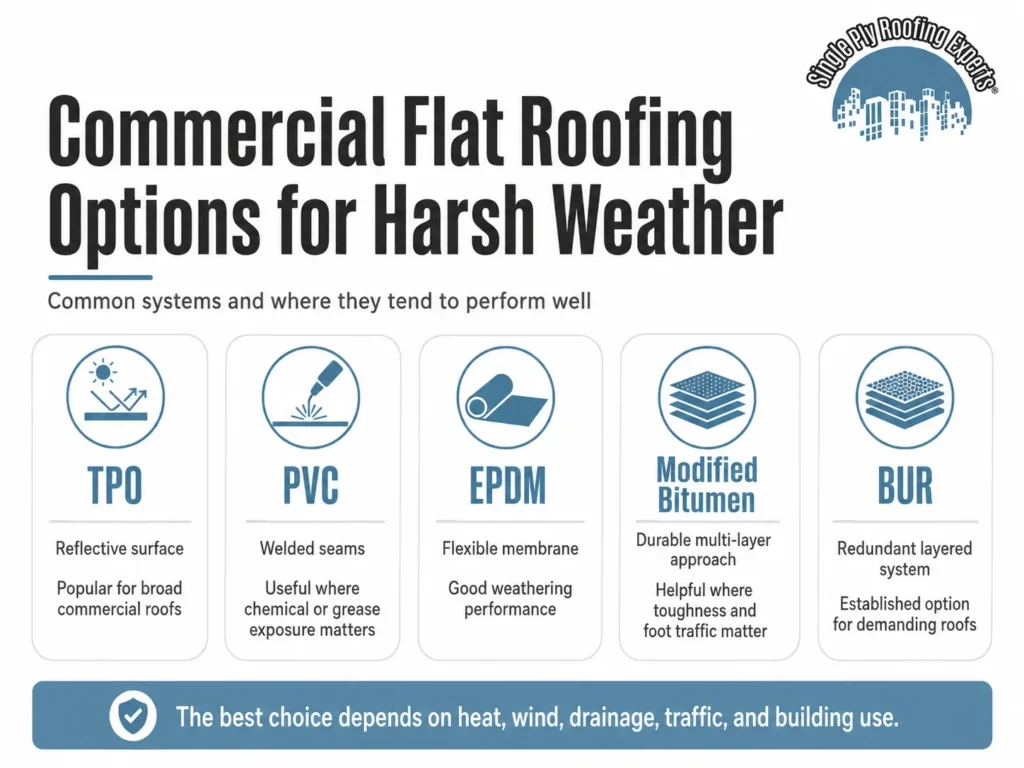
There is no single winner among the best commercial flat roofing solutions for harsh weather conditions. TPO, PVC, EPDM, modified bitumen, and BUR each bring different strengths, and the final choice should reflect both environmental exposure and how the property is used.
| Roofing system | Notable strengths | Conditions to evaluate carefully | Common commercial fit |
| TPO | Reflective options, welded seams, lightweight | Puncture exposure, attachment, detailing | Warehouses, retail, offices |
| PVC | Welded seams, chemical and grease resistance | Product compatibility, traffic protection | Restaurants, industrial, commercial |
| EPDM | Flexibility, weathering resistance | Seam/details, dark-surface heat gain depending on product | Large low-slope roofs |
| Modified bitumen | Multi-layer toughness, puncture resistance | Heat exposure, installation method, surfacing | Equipment-heavy and service roofs |
| BUR | Multiple plies, redundancy | Weight, installation complexity, existing structure | Established commercial/industrial roofs |
| Roof coatings | Seamless restoration potential, reflective options | Existing roof condition, moisture, adhesion | Serviceable roofs suitable for restoration |
TPO Roofing
TPO is widely used on commercial flat and low-slope properties. Its thermoplastic membrane is joined with heat-welded seams, and reflective membrane options can be useful where solar exposure and cooling demand are important considerations.
A TPO roof designed for harsh conditions needs more than a white membrane. Attachment, perimeter enhancement, flashing, cover-board selection, drainage, seams, penetrations, and rooftop traffic all contribute to performance.
TPO can be a strong option for warehouses, retail centers, offices, multifamily properties, and other broad commercial roof areas when the system is correctly specified for the building.
PVC Roofing
PVC shares the heat-welded seam approach of other thermoplastic roofing systems but is particularly worth evaluating on properties exposed to grease, oils, chemicals, or other operational contaminants.
Restaurants, food-related facilities, manufacturing environments, and certain industrial buildings may therefore have reasons to consider PVC beyond weather exposure alone.
As with TPO, the weather performance of PVC depends on the complete assembly. Penetrations, drains, attachment, edge details, insulation, and protection around high-traffic areas cannot be ignored.
EPDM Roofing
EPDM is a synthetic rubber membrane known for flexibility and long-term weathering characteristics. That flexibility can be useful where the roof assembly experiences repeated temperature-related movement.
EPDM can work effectively on large commercial roof areas, but seam construction, flashing details, penetration treatment, drainage, and attachment remain critical.
Where a darker membrane is proposed in a very hot climate, solar heat gain and the building’s energy goals should also be part of the decision.
Modified Bitumen and Built-Up Roofing
Modified bitumen and BUR offer asphalt-based approaches that can provide layered protection and physical toughness.
Modified bitumen can be particularly useful where rooftop service traffic or puncture resistance is a significant concern. BUR creates redundancy through multiple reinforcing and asphaltic layers.
These assemblies can be effective in demanding environments, but roof weight, installation logistics, surfacing, heat exposure, building occupancy, and existing conditions should all be assessed before selection.
What Is the Best Flat Roofing Solution for Extreme Heat and UV?
For properties where heat and UV are the main concern, the best commercial flat roofing solutions for harsh weather conditions should combine weather-resistant materials with thoughtful thermal design. Membrane color alone does not determine how the building will perform.
Reflective TPO and PVC Systems
Light-colored thermoplastic membranes can reflect more incoming solar energy than darker roof surfaces.
For conditioned warehouses, offices, retail properties, multifamily buildings, and similar facilities in warm climates, reflective roofing may support efforts to control rooftop heat gain. The effectiveness depends on climate, insulation, HVAC operation, building use, and roof condition.
Reflectivity should therefore be treated as one performance characteristic rather than the entire roofing decision.
Insulation Matters Below the Membrane
A high-performance membrane installed over an inadequate or damaged insulation package does not automatically create an efficient roof.
Roof insulation helps control heat transfer between exterior conditions and the building interior. During replacement, the insulation configuration should be evaluated together with deck condition, existing moisture, roof height, curbs, drainage, and applicable energy requirements.
Commercial owners exploring these options can review Single Ply Roofing Experts’ best commercial flat roofing solutions for harsh weather conditions to understand the broader range of flat-roof systems available.
How Should a Commercial Roof Be Designed for High Winds and Storms?
The membrane is only one part of the best commercial flat roofing solutions for harsh weather conditions in high-wind areas. Attachment, edge systems, deck condition, roof zones, flashings, penetrations, and rooftop equipment can determine whether the complete assembly stays intact during severe weather.
Roof Corners and Perimeters Need Attention
Wind pressures are not uniform across the entire roof.
Corners and perimeter zones can experience greater uplift forces than central areas, making fastening, adhesion, edge metal, flashing, and system design especially important in those locations.
A roofing system should therefore be specified according to actual building conditions and applicable wind-design requirements rather than using the same attachment pattern everywhere without analysis.
Rooftop Equipment Must Be Part of Storm Planning
Commercial roofs frequently support HVAC units, vents, curbs, conduits, solar systems, access hatches, and other equipment.
These components create transitions in the waterproofing system and can also become part of the wind-risk picture. Flashing around equipment must remain watertight, while loose or poorly secured rooftop components can damage a membrane during severe weather.
Storm preparation should therefore include both the roof and what is installed on top of it.
Why Roof Assembly Details Matter More Than the Membrane Alone
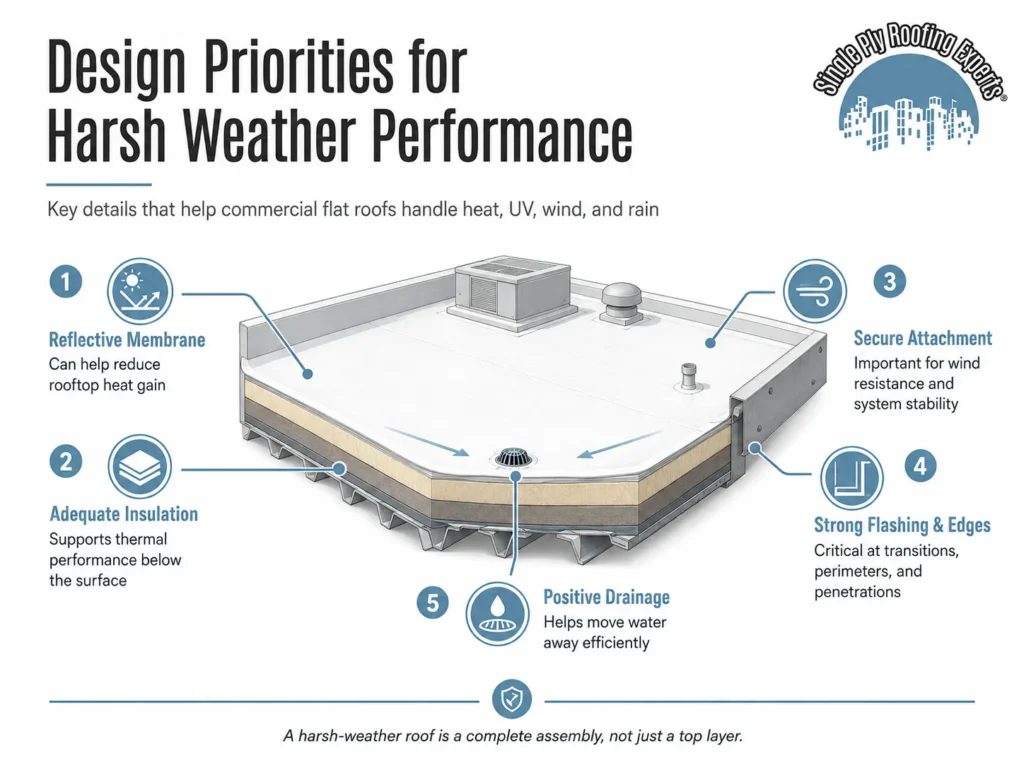
One of the most overlooked aspects of the best commercial flat roofing solutions for harsh weather conditions is that a roof is an assembly, not simply a sheet of TPO, PVC, EPDM, or modified bitumen. Two buildings using the same membrane can perform very differently because of what sits below and around it.
Cover Boards Can Add Protection
Depending on the assembly, a compatible cover board can provide a more stable substrate and additional protection between the membrane and insulation.
This can be valuable on roofs exposed to maintenance traffic, equipment servicing, or other physical stresses. The appropriate board, thickness, fastening, and compatibility should follow the specified roof system rather than being added generically.
Drainage Is Part of Weather Resistance
A membrane may be waterproof, but repeated ponding and poor drainage still place unnecessary stress on a commercial roof.
Drains, scuppers, gutters, overflow systems, slope, and tapered insulation should be evaluated as part of a reroofing or major repair project.
A new membrane should not automatically be installed over an unresolved drainage problem if the replacement project provides a practical opportunity to correct it.
When Can Roof Coatings Help With Harsh Weather?
Roof coatings can be part of the best commercial flat roofing solutions for harsh weather conditions when the existing roof is fundamentally serviceable and compatible with restoration. They should not be treated as a universal substitute for repairing or replacing a failing roof.
Reflective Coatings for Solar Exposure
Compatible reflective coatings may reduce solar absorption and provide a renewed protective surface over certain existing roof systems.
Silicone, acrylic, and other coating technologies have different application conditions and performance characteristics. The existing substrate, drainage, moisture, adhesion, repairs, climate, and manufacturer requirements should be evaluated before a coating system is selected.
Coatings Cannot Fix Every Roof
A roof with widespread trapped moisture, failing decking, severe membrane deterioration, major drainage problems, or extensive structural concerns may need more than a coating.
Applying a restoration system over unresolved defects can conceal problems rather than correct them.
A roof-condition assessment should therefore determine whether restoration, repair, recover, or replacement offers the better lifecycle approach. Single Ply Roofing Experts’ roof waterproofing services provide a relevant next step for properties considering protective or waterproofing solutions.
How Maintenance Improves Performance in Harsh Weather
Even the best commercial flat roofing solutions for harsh weather conditions need inspection and maintenance. Severe weather rarely respects the installation date, and minor defects can become more serious when exposed to heat, wind, rain, hail, or repeated rooftop activity.
Inspect Before and After Severe Weather
A pre-season inspection can identify open seams, damaged flashing, loose edge components, clogged drains, punctures, deteriorated coatings, or other conditions before a major storm tests them.
After severe weather, the roof should be checked again for new damage, particularly around perimeters, penetrations, drains, rooftop equipment, and areas exposed to debris.
For commercial properties, Single Ply Roofing Experts provides professional roof inspection services that can help establish current condition before deciding whether maintenance, repair, or replacement is appropriate.
Keep Drains and Service Areas Clear
Commercial roofs accumulate leaves, packaging, construction debris, HVAC-service materials, and other objects over time.
Blocked drainage can turn a manageable rain event into prolonged ponding. Service technicians can also accidentally puncture membranes or damage flashing while maintaining rooftop equipment.
A maintenance plan should therefore include drainage, access paths, membrane condition, seams, penetrations, and rooftop equipment areas rather than focusing only on obvious leaks.
Choosing a Roof for California, Arizona, and Nevada Weather
Climate should directly influence the best commercial flat roofing solutions for harsh weather conditions in California, Arizona, and Nevada, but these markets should not be treated as one identical environment. Coastal exposure, desert heat, monsoon storms, high winds, elevation, and local rainfall patterns vary substantially.
Arizona and Nevada Heat
Commercial properties in hot inland areas may place a high priority on UV resistance, reflective roofing, insulation, rooftop heat management, and materials appropriate for sustained high temperatures.
Seasonal storms and wind still matter. A roof designed only around summer heat may overlook drainage and uplift concerns that become important during short but intense weather events.
California Conditions Vary Widely
California roofing conditions can range from hot inland valleys and desert environments to coastal locations and higher elevations.
Properties may face combinations of heat, wind, rain, marine exposure, rooftop equipment, and local energy requirements. The system should therefore be selected for the specific property and jurisdiction, not simply because the building is located somewhere in California.
Frequently Asked Questions About Commercial Flat Roofing for Harsh Weather
Property owners comparing the best commercial flat roofing solutions for harsh weather conditions usually want to know which membrane handles heat, storms, hail, and heavy rain best. The answer depends on the particular exposure and the complete roof assembly.
What Is the Best Commercial Flat Roof for Extreme Heat?
Reflective TPO and PVC systems are often considered where solar heat exposure is a major concern. Insulation, roof assembly design, building use, and local conditions still need to be evaluated before selecting a system.
Which Commercial Roof Is Best for High Winds?
No membrane alone guarantees high-wind performance. Attachment, deck condition, corners, perimeter enhancement, edge metal, flashing, rooftop equipment, and tested assembly design are all important.
What Roofing System Is Good for Hail?
Impact performance depends on the complete roof assembly, including membrane, cover board, insulation, substrate, and severity of the hail event. Physical toughness and appropriate impact-resistant assemblies may be priorities in hail-exposed locations.
Is TPO Good for Harsh Weather?
TPO can be a strong commercial roofing option when correctly specified and installed. Reflective options, welded seams, and broad commercial applicability make it worth considering, but puncture protection, wind design, flashing, drainage, and maintenance still matter.
Is PVC Better Than TPO?
Not universally. PVC may be attractive for properties exposed to grease, chemicals, or specific operational conditions. TPO may suit other commercial applications. Building use and exposure should drive the decision.
Is EPDM Good for Extreme Weather?
EPDM’s flexibility and weathering characteristics can make it suitable for demanding environments. Seam design, membrane protection, attachment, drainage, and heat-related considerations should still be evaluated.
Can a Roof Coating Protect Against Harsh Weather?
A compatible coating can improve waterproofing or reflectivity on a suitable existing roof, but it cannot correct every structural, moisture, drainage, or membrane problem.
Should a Commercial Roof Be Inspected After a Major Storm?
Yes. A post-storm inspection can identify membrane damage, flashing problems, blocked drainage, perimeter issues, punctures, and other conditions before they develop into larger leaks or property damage.
Conclusion
The best commercial flat roofing solutions for harsh weather conditions are not determined by a single material ranking. TPO, PVC, EPDM, modified bitumen, BUR, and roof coatings all have places in commercial roofing, but their performance depends on the complete assembly and the conditions the building actually faces.
For one property, extreme heat and UV exposure may make reflectivity and insulation major priorities. Another building may need stronger emphasis on wind design, drainage, puncture resistance, chemical exposure, rooftop traffic, or multi-layer protection. In many cases, the condition of the existing roof and deck will determine whether repair, restoration, recover, or replacement provides the better long-term approach.
Single Ply Roofing Experts works with commercial flat and low-slope roofing systems across California, Arizona, and Nevada, including single-ply membranes, modified bitumen, waterproofing, coatings, repair, inspection, and replacement. Our role is to evaluate the property first, understand the actual exposure and roof condition, and then determine which roofing approach fits the building rather than forcing every project into the same system.
If your commercial or residential flat roof is exposed to extreme heat, storms, recurring leaks, high winds, or deteriorating conditions, start with a professional assessment. Book a free inspection to determine whether the roof needs targeted repairs, improved waterproofing, restoration, or a complete replacement.